


Tuesday, January 20, 2009
I thought about writing a final post musing on copyright and the commons, but currently I'm working on my chapter on colonial copyright, and I'm looking forward to getting back to it. And if I was going to muse on any topic it would be that: colonial copyright, or historical copyright issues. When I started my PhD a little under a three years ago, I knew that my thesis would involve 'mapping Australia's copyright commons' - that is its (current) title after all - but it wasn't until I started looking at the various colonial statutes, and then the Copyright Act 1905 (Cth) that a number of distinctly Australian issues began to emerge. In the end, I think I've ended up writing about 10 percent of what I originally planned to, because so many different issues came up from these older statutes that are still relevant to, and have an impact on, the Australian public domain and the creations contained within that space today.
I won't go into the details of this now; with the upcoming Unlocking IP 2009 conference coming up, that is a more appropriate forum. So I'll finish off with a few thank yous...to my fellow housemates Abi Paramaguru, Ben Bildstein and Sophia Christou, who will fill you in on all the juicy copyright gossip during my absence; my supervisors, Kathy Bowrey and Graham Greenleaf; and to you, our wonderful readers, for your support and engagement with our blog.
I'll be back at the House of Commons in June, look forward to writing to you all then!
P.S. There is, of course, one exception to my blogging vacation: if the Federal Government responds to the Copyright Law Review Committee Crown Copyright report. Will we get to four years without a response...?
Labels: catherine


Saturday, November 01, 2008
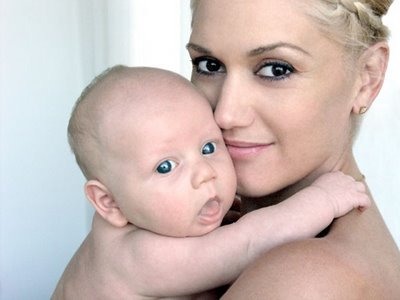
Photo: Dennis Stefani, (c) Mrs. Me, Inc., 2008, made available under a CC
BY-NC-ND license
Pop star Gwen Stefani and her husband, rocker Gavin Rossdale recently
welcomed a baby, Zuma Nesta Rock Rossdale, into the world. Many celebrities
contract with a magazine to arrange an exclusive photo session that debuts
mother with newborn. But Stefani and Rossdale took a different approach and
hired their own photographer and put the photo online for the public under a
Creative Commons BY-NC-ND license, along with some additional terms that allow all print magazines, newspapers, and blogs to use the photo - even commercially, with some restrictions. You can download a high-res version of the photo (and check out the additional terms the photo is available under) at Stefani’s site.
Labels: catherine, Creative Commons
Tuesday, October 28, 2008
Today I attended a briefing session on ACTA hosted by the Australian
Department of Foreign Affairs and Trade (DFAT). I felt it was a good meeting,
and I really got the sense that DFAT were interested in public participation.
There was a good deal of frustration on both sides of the fence – participants
expressed serious concerns about the lack of transparency in the negotiating
process, and DFAT consistently repeated that they were bound by confidentiality
agreements and could not divulge details of the draft text of the agreement.
Participants in the Tokyo round of negotiations agreed that the full text of the
agreement will only be made available after negotiations have been concluded and
the text finalised. Understandably, there were a number of members of the
audience who were hesitant to accept any of DFAT's assurances as to the content
of the agreement without access to the negotiation documents.
Overall, whilst I think that the process is far too secretive, DFAT appear
to have gone a long way to make available what they can, and they seem genuinely
interested in hearing from interested parties in Australia. Unfortunately, input
will be limited (blind) until negotiations are complete and the text finalised,
but DFAT assures us that they are considering the issues thoroughly and there
will be genuine opportunity to debate whether or not to sign at the end of the
process.
The big points I would take away from the meeting are:
- Negotiations will go 'well into 2009';
- The Commonwealth Government is not seeking to drive domestic changes through
ACTA.- Overall, there do not appear to be any great changes to Australia's
enforcement regime – it appears to be more focused on affecting other
states;- The Government intends to limit the effect of any treaty to trademark
infringement and commercial scale copyright infringement;- However, statutory damages for copyright infringement are on the table;
- Next meeting, in December, will consider internet distribution;
- Camcording is likely to be criminalised;
- There's still time to make relevant submissions to DFAT – indeed, they
release a substantial amount of information once they receive the draft
proposals before every negotiation round;- DFAT has a copy of the Cutler report.
Interested readers should head over to Nic's site to read the rest (and also have a look at the outline of Nic's PhD on 'Virtual environments and digital constitutionalism' - looks as though it will be an immense contribution to this area).
Labels: Anti-Counterfeiting Trade Agreement, catherine
Sunday, October 26, 2008
Yet there are a few things that to me lessened the impact of the book. My criticisms of Remix are basically two-fold, and these won't bother everyone. The first is - and you can criticise me for stating this - the essentially all-American focus. Lessig talks about how we are damaging 'our children', when clearly this is really 'our children in the western world with access to a computer'. This may seem an unfair criticism; not every book needs to address the disparity between developed and developing countries and Internet access, but Lessig does not even acknowledge this point. This is a particular shame given that Creative Commons licences are now being ported to many different jurisdictions and it would have been a good opportunity to show how the concept of 'remix' works in these jurisdictions. Perhaps Lessig might address this in the future.
The All-American focus also bothered me with regard to Lessig's recommendations for legal reform. Again, Lessig pioneers the, 'let's make copyright an opt-in system and reduce the length of protection' position. Let me say this once and for all, to all those Americans out there who have made the same or similar points: THE BERNE CONVENTION EXISTS. I'm sorry. I didn't mean to do the keyboard equivalent of yelling. But I imagine my future thesis examiners will not be impressed if I make a number of suggestions for reform that completely ignore the reality of Australia's international obligations. The Berne Convention dictates a certain period of protection for works and other subject matter and, in fact, the United States has extended its protection beyond that minimum (and indeed made Australia do the same). Suggestions for reform that ignore these obligations are essentially useless. We need to start thinking about reforms that work within the current system and, admittedly, Lessig does so, for example, by suggesting a simplification of current copyright law. But choosing to ignore the reality of international obligations lessens the impact of those other suggestions, unless Lessig is willing to address this issue at an international level.
My second point is that I think Lessig needs to reconsider who his target audience is. Lessig writes about the impact of blogs; he writes about Wikipedia; he writes about YouTube, Amazon, Google, Flickr. The trouble is the people who will read Remix and ordered his book as quickly as I did, will be individuals who blog; have edited Wikipedia; shopped on Amazon.com; and use Google, YouTube, and Flickr. They may have some legal knowledge (at the very least a brush with copyright law). They will probably also be American, actually.
Thus the majority of Lessig's readers, particularly those who buy the first run of Remix, probably know as much about his modern examples as he does. In fact, Lessig himself has encouraged this, by creating wikis for his books that his readers can directly contribute to. So there is no reason any more to re-write the details of Wikipedia's birth. Benkler has done it. Zittrain has done it. Lessig has done it. Even I have done it. Let there be no more, please.
This may seem a harsh criticism, and certainly there will be people who read Remix and this is their first brush with such a brave new world. But if you are reading this review, then you probably know a reasonable amount about this area anyway, and can probably see where I am coming from.
Despite these criticisms, as I said before overall I did enjoy Remix...and, in the spirit of the hybrid economy that Lessig writes about, I look forward to contributing to the Remix wiki, and not receiving any payment for that.
Labels: book review, catherine, lessig
Monday, October 20, 2008
An Envisional study found Australia was the second-largest downloader of online
pirated TV shows in the world (15.6%), behind the UK (18.5%) but ahead of the US
(7.3%). Australians were the leading downloaders of pirated TV programs on a per
capita basis. The report found that increased bandwidth take-up, technological
advances and a high demand for US-based TV shows are some of the reasons that
piracy has boomed. Seventy percent of the piracy occurs through BitTorrent (BT)
(Envisional 2004, BBC News 2005, Reuters 2005). The survey found that the top TV show downloads were 24, Stargate Atlantis, The Simpsons, Enterprise, Stargate
SG-1, OC, Smallville, Desperate Housewives, Battlestar Galactica and Lost (Idato
2005).
Australia is, and has always been, since colonial times, an importer or 'user' nation of copyright-protected materials, so it came as no surprise to me that we were the second-largest illegal downloader of television shows. The fact that Australia is an 'importer nation' was picked up in the Spicer Committee's report and then later with regard to the intellectual property package of the AUSFTA. Back in the ye olde colonial days, the majority of our books were imported from the United Kingdom, with many UK publishers and then eventually some colonial publishers, producing specific 'colonial editions' for sale in Australia. As Martyn Lyons has noted in a chapter of the fantastic A History of the Book in Australia 1891 - 1945, Australia earned itself the reputation as being 'the jewel of Britain's book trade empire.' (see Martyn Lyons, 'Britain's Largest Export Market', in Lyons & Arnold (eds) A History of the Book in Australia 1891 - 1945, 2001, at p. 19).
Until about five years ago, a similar statement could be made regrding Australia's importation of international television shows, predominantly from the United States and, to a lesser extent, the United Kingdom (I think The Bill and Jane Austen miniseries adaptations would comprise a lot of that market!) And, just as in the colonies Australian readers had to pay a considerable amount more than their UK counterparts to purchase the latest fiction, Australians had to wait a long time to see new episodes of their favourite TV shows.
The West Wing is an excellent example - originally it was aired on the Nine Network, who changed the time and date of broadcast so often that many viewers began to resort to Amazon.com to get the latest series on DVD. Eventually (thankfully) it was picked up by the ABC and the sixth and seventh seasons were shown weekly until the end of the series.
With examples like this, it is really no surprise that Australians have turned to the Internet to catch their favourite shows just after they have been aired in the United States. This is not to suggest that I support this type of behaviour but it poses a challenge to the free-to-air networks in Australia to change their business models, and I know a number have. In an article published yesterday in the Sun-Herald newspaper (accessible of the Sydney Morning Herald website here) it is noted that shows such as House and the US version of Kath & Kim are appearing about one-three days after they appear in the States. Yet some very popular shows, for example, Heroes, are still taking over a fortnight to get to our screens, though that is still being described as 'fast-tracked'. Not fast enough, clearly.
Labels: catherine, copyright, enforcement, infringement, piracy
Sunday, October 19, 2008
The proceedings began on Thursday morning and the Australian Digital Alliance and Telstra were both granted amicus status, the ADA for IceTV and Telstra for Nine Network. David Catterns, the barrister who successfully argued for CAL in the recent CAL v NSW decision appeared for Telstra. The hearing took the better part of Thursday and Friday and the transcript of the Thursday proceedings can be found on AustLII here.
As I said, this is the first of a few posts on the hearing, so I will have more of a discussion up within the next few days.
Labels: cases, catherine, copyright, High Court of Australia
Thursday, October 02, 2008
Professor Kathy Bowrey, author of Law and Internet Cultures and House of Commons friend (and one of my supervisors), has recently penned an article on these issues, titled 'On clarifying the role of originality and fair use in 19th century UK jurisprudence: appreciating "the humble grey which emerges as the result of long controversy"'. Kathy's article has a slightly different focus: tackling originality in 19th century case law and how this concept developed. The abstract states:
Understanding nineteenth century precedent is one of the more difficult tasks inYou can find it in the UNSW Law Research Series here and for any readers interested in the forthcoming IceTV case this is a must-read. Two weeks to go...
copyright today. This paper considers why the nineteenth century cases and
treatises failed to clearly identify what the author owns of “right” and the
implications for the criterion of originality and for determining infringement
today.
Labels: cases, catherine, copyright, High Court of Australia, infringement, research
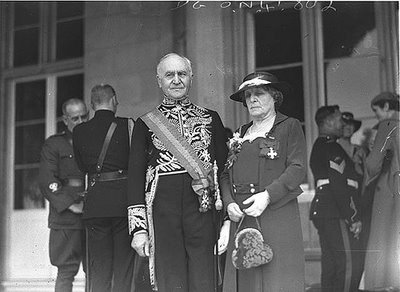 Sir Isaac Isaacs and Lady Isaacs, photographed by Sam Hood, from the collections of the Mitchell Library, State Library of New South Wales, featured on the SLNSW Flickr photostream here, persistent URL here.
Labels: books, catherine, copyright, High Court of Australia
Thursday, September 18, 2008
Labels: cases, catherine, High Court of Australia
Tuesday, September 09, 2008
"The (Lexicon) took an enormous amount of my work and added virtually noAccording to reports it is likely that the decision will be appealed. More can be read at the Sydney Morning Herald here or for those in the mood for some lighter reading, at the Internet Movie Database here.
original commentary of its own. Now the court has ordered that it must not be
published"...
"Many books have been published which offer original insights into the
world of Harry Potter. The Lexicon just is not one of them."
Labels: books, cases, catherine, fair use, infringement
Tuesday, August 26, 2008
Thursday, August 14, 2008
THE “IP” Court Supports Enforceability of CC Licenses
Brian Rowe, August 13th, 2008The United States Court of Appeals held that “Open Source” or public license licensors are entitled to copyright infringement relief.
The Court of Appeals for the Federal Circuit (CAFC), the leading IP court in the United States, has upheld a free copyright license, while explicitly pointing to the work of Creative Commons and others. The Court held that free licenses such as the CC licenses set conditions (rather than covenants) on the use of copyrighted work. As a result, licensors using public licenses are able to seek injunctive relief for alleged copyright infringement, rather than being limited to traditional contract
remedies.Creative Commons founder Lawrence Lessig explained the theory of all free software, open source, and Creative Commons licenses upheld by the court: “When you violate the condition, the license disappears, meaning you’re simply a copyright infringer. This is the theory of the GPL and all CC licenses. Put precisely, whether or not they are also contracts, they are copyright licenses which expire if you fail to abide by the terms of the license.” Lessig said the ruling provided “important clarity and certainty by a critically important US Court.”
Today’s ruling vacated the district court’s decision and affirmed the availability of remedies based on copyright law for violations of open licenses. The federal court noted that ignoring attribution requirements contained in the license caused reputation and economic harm to the original licensor. This opinion demonstrates a strong understanding of a basic economic principles of the internet; attribution is a valuable economic right in the information economy. Read the full opinion.(PDF)
Creative Commons filed a friends of the court brief in this case. Thanks to all the cosponsors Linux Foundation, The Open Source Initiative, Software Freedom Law Center, the Perl Foundation and Wikimedia Foundation. Significant pro bono work on this brief was provided by Anthony T. Falzone and Christopher K. Ridder of Stanford’s Center for Internet & Society. Read the full brief.
Labels: cases, catherine, copyright, Creative Commons, enforcement, free software, open source
Thursday, August 07, 2008
So at the end of my last post I suggested that, if the Government introduced new free use provisions, based on the UK legislative model, to deal with the decision of the High Court in CAL v NSW, then there may be some constitutional problems in doing so. I mentioned two provisions - section 51(xviii), the constitutional copyright power; and section 51(xxxi), the power with respect to acquisition of property on just terms.
Any arguments with respect to section 51(xviii) can arguably be easily dealt with. What's interesting about this power is that, for a long time, it was believed that the Parliament could actually do very little with respect to copyrights because of the narrow interpretation given in the decision of Attorney-General (NSW) ex rel Tooth & Co Ltd v Brewery Employees' Union of NSW [1908] HCA 94; (1908) 6 CLR 469. In that case it was found that the union label trade mark wasn't valid because such marks were not around in 1900, when the Constitution was framed. On that basis, for about eighty-five years it was believed that section 51(xviii) gave the Parliament very narrow power with respect to making IP laws. However, the 1994 decision Nintendo Co Ltd v Centronics Systems Pty Ltd [1994] HCA 27; (1994) 181 CLR 134 and then the subsequent 2000 decision Grain Pool of Western Australia v Commonwealth [2000] HCA 14; 202 CLR 479 - revealed that the HCA believed that section 51(xviii) was quite a wide power, leading to broader concerns that there might not actually be any limits on section 51(xviii).
As such, given this broad interpretation, it would be unlikely that such free use exceptions would fall foul of section 51(xviii), unless some sort of constitutional argument could be raised that the term "copyrights" as it appears in the Constitution requires that remuneration be given to the copyright owner. That, however, would probably cause all types of chaos, and is therefore unlikely. It would be interesting to run though...however, in light of the CAL v NSW decision, I am in no hurry to get another copyright case before the HCA.
It is the second provision, however, that may cause constitutional difficulties for these types of exception. Section 51(xxxi) has occasionally popped up in IP decisions over the last fifteen years (see Australian Tape Manufacturers Association Ltd v Commonwealth [1993] HCA 10; (1993) 176 CLR 480 and Stevens v Kabushiki Kaisha Sony Computer Entertainment [2005] HCA 58; (2005) 221 ALR 448). This constitutional section was actually mentioned at several points in the joint judgment of CAL v NSW:
At [57]: In any event, with an echo of s 51(xxxi) of the Constitution, the Spicer Committee made its recommendation for government use of copyright material in the following terms:[51]
"The Solicitor-General of the Commonwealth has expressed the view that the
Commonwealth and the States should be empowered to use copyright material for
any purposes of the Crown, subject to the payment of just terms to be fixed, in
the absence of agreement, by the Court. A majority of us agree with that view.
The occasions on which the Crown may need to use copyright material are varied
and many. Most of us think that it is not possible to list those matters which
might be said to be more vital to the public interest than others. At the same
time, the rights of the author should be protected by provisions for the payment
of just compensation to be fixed in the last resort by the Court." (emphasis
added).
And then again at paras [68] - [69]:
The purpose of the scheme is to enable governments to use material subject to copyright "for the services of the Crown" without infringement. Certain exclusive rights of the owner of "copyright material" are qualified by Parliament in order to achieve that purpose. It is the statutory qualification of exclusive rights which gives rise to a statutory quid pro quo, namely a statutory right in the copyright owner (here a surveyor) to seek "terms" upon which the State (excepted from infringement by the legislature) may do any act within the copyright (s 183(5)) and to receive equitable remuneration for any "government copies" (s 183A). With reference to the use by the Spicer Committee of the constitutional expression "just terms", it may be added that CAL conducted its case in this Court on the footing that the statutory scheme afforded "just terms" to copyright owners.
Given that CAL proceeded on the basis that the Crown use of copyright statutory licence scheme was "just terms" under section 51(xxxi), then it is arguable that removing this financial aspect may put such a provision in breach of section 51(xxxi). This may particularly be the case if the government continued to charge for the use of the survey plans. Certainly, as the law currently stands, it is available to the Government to use the fair dealing and other exceptions provided in the 1968 Act (in fact, as noted in the CAL v NSW joint judgment, if these provisions apply, then the statutory licence scheme doesn't - see paragraph [11].) However, would the inclusion of provisions that give the government a free pass to use copyright-protected works created by others, for fulfilment of their statutory obligations and what reasonably flows from those obligations, be valid under section 51(xxxi)?
In conclusion, although I have dedicated a whole chapter in my doctoral thesis to determining the boundaries of the copyright power of the Constitution and the concurrent effect on the Australian public domain, I will admit that future intellectual property cases are less likely to be concerned with section 51(18) and more to do with section 51(31). And, to end on a lighter note, that makes The Castle required viewing for anyone involved in intellectual property!
Labels: cases, catherine, copyright, Crown copyright, High Court of Australia, licensing
In the course of the decision, the High Court referred to the position in other jurisdictions with respect to Crown use of copyright works. It cited the UK position under the Copyright, Designs and Patents Act 1988 (UK) and the different types of what it would describe as "free use provisions" under that law. These are exceptions to infringement on the grounds of different types of public administration:
- Section 45 -"Copyright is not infringed by anything done for the purposes of parliamentary or judicial proceedings" and the reporting of such proceedings;
- Section 46 - "Copyright is not infringed by anything done for the purposes of the proceedings of a Royal Commission or statutory inquiry", its reporting and the issue to the public of a report of the Royal Commission or statutory inquiry;
- Section 47 - Where material is open to public inspection due to a statutory requirement or statutory register, copyright is not infringed in a literary work in certain cases and not including the issuing of the work to the public; however pursuant to section 47(2) "copyright is not infringed by the copying or issuing to the public of copies of the material, by or with the authority of the appropriate person, for the purpose of enabling the material to be inspected at a more convenient time or place or otherwise facilitating the exercise of any right for the purpose of which the requirement is imposed" etc.
- Section 48 -The Crown can communicate material to the public in the course of public business, and "copy the work and issue copies of the work to the public without infringing any copyright in the work."
- Section 49 - Material comprised in public records can be copied and supplied to any person without infringing copyright.
- Section 50 - "Where the doing of a particular act is specifically authorised by an Act of Parliament, whenever passed, then, unless the Act provides otherwise, the doing of that act does not infringe copyright."
Even without that distinction, however, another argument rears its head: the constitutionality of introducing such free use provisions. Two sections of the Australian Constitution would arguably be involved: section 51(xviii), which gives the Federal Parliament the power to make laws with respect to "Copyrights, patents of inventions and designs, and trade marks"; and section 51(xxxi), which also provides power to the Federal Parliament to make laws with respect to "The acquisition of property on just terms from any State or person for any purpose in respect of which the Parliament has power to make laws."
I have just realised that this post is getting very long, so it is going to be split into two. Constitutional analysis forthcoming!
Labels: cases, catherine, copyright, Crown copyright, High Court of Australia, licensing
Tuesday, August 05, 2008
On the Amazon.com page Remix is also described as "an urgent, eloquent plea to end a war that harms our children and other intrepid creative users of new technologies. It also offers an inspiring vision of the post-war world where enormous opportunities await those who view art as a resource to be shared openly rather than a commodity to be hoarded". Them's fightin' words...
Monday, August 04, 2008
The review received a whopping number of submissions - according to a media release from Dr. Cutler, about 630 - including one from Professor Graham Greenleaf, Chief Investigator of the Unlocking IP project here at UNSW, titled Unlocking IP to stimulate Australian innovation: An Issues Paper. Find it on Bepress as part of the UNSW Law Research Series here.
The committee was supposed to report to the Government by the end of July, but shortly after that time lapsed Dr. Cutler applied for an extension of time, and this has been granted by Senator Carr. According to the Review into Australia's Innovation System website, we can now expect the report sometime in September. You can also read more in Stephen Marchett's report in The Australian here, which describes this development as a "shock announcement".
Labels: catherine
Thursday, July 31, 2008
Whenever a new judge is appointed to the High Court, questions always arise as to the types of decision that judge is likely to make. In a Sydney Morning Herald article on the new appointment political commentator Mark Davis notes that Justice French was one of the judges who recently struck down the World Youth Day laws passed by the NSW Parliament that made it illegal to "annoy" pilgrims at that event. However, as the article also notes, "he was also one of the judges who upheld the Howard government's move in 2001 to block refugees on the the Tampa entering Australia."
Being a keen copyright researcher, however, I was interested in the previous copyright law decisions of the new Chief Justice - and there are quite a few. Indeed, Justice French has sat on many of the significant copyright decisions of the previous decade. Justice French was one of the members of the Full Federal Court who in Kabushiki Kaisha Sony Entertainment v Stevens found that the access code in Sony Playstation games and the BootROM of the Sony Playstation constituted a technological protection measure that was circumvented by Stevens' mod chips , a decision that was subsequently overturned by the High Court. His Honour also was one of the members of the Full Court in Cooper v Universal Music Australia, where authorisation of copyright infringement via online downloading was found to occur.
To me, however, the most interesting judgment of Justice French was in Venus Adult Shops Pty Ltd v Fraserside Holdings Ltd. This was a joint judgment written by French J and another member of the Federal Court who has subsequently been appointed to the High Court, Justice Susan Kiefel. To cut a long copyright case short, in that decision the Full Federal Court considered the infringement of copyright in a number of pornographic films. As part of their decision, French and Kiefel JJ considered whether copyright could be denied to such materials based on their illegality (adult films are actually illegal in most Australian jurisdictions), or whether the remedies available to the plaintiff could be limited on the basis of their content. On the former argument, their Honours stated that (at para. 84):
There is therefore no statutory basis under existing Australian copyright lawIt will be interesting to see, should a relevant case arise in the future, public policy will play any role in determining the remedies in those decisions.
for a finding that copyright does not subsist because the content of the
relevant work or subject matter offends against community values or standards.
That is not to say that such considerations may not inform the discretion to
award particular classes of remedy but the scope of such an exercise of
discretion would seem to be narrow.
Labels: catherine, copyright, High Court of Australia
Wednesday, July 30, 2008
As regular readers will know, I love a good copyright case, but to be honest with you, there's something about the way Australian courts have dealt with compilation copyright that just makes me want to bang my head on a table. That said, I thought that David's seminar was very good. It will be interesting to see whether the case goes to the High Court, given its previous rejection of the special leave to appeal Desktop Marketing v Telstra, a case with the capability to destroy the spirit of even the most passionate copyright scholar.
Friday, July 25, 2008
Google, being the smart world-dominating search engine that it is, has come up with a nifty business model to entice authors to contribute to Knol: if contributors "choose, [they can] have ads displayed through the Internet search leader's marketing system. The contributing author and Google will share any revenue generated from the ads, which are supposed to be related to the topic covered in the knol."
According to the report, Knol "has been widely viewed as the company's answer to Wikipedia", although reports from Google say it's supposed to "supplement" Wikipedia. And in true Wikipedia form, you can find the Wikipedia page on Google's Knol here.
Sadly yours truly was not on the original Knol invite list...Google must not know about my obssessive knowledge of colonial copyright...or The Dark Knight.
Labels: catherine, Google, wikis
Tuesday, July 08, 2008
Representatives from Australia include members of the Creative Commons Australia team, Delia Browne and our very own Ben Bildstein. Ben will be presenting on quantification of the digital commons, and if you've been following Ben's work about quantification here at the House of Commons, then you won't want to miss his presentation (read more about it here).
And that's enough of a shameless plug for one day...
Labels: ben, catherine, conferences, Creative Commons
Wednesday, June 25, 2008
uwacomm2203, 'Citizen Journalism v Traditional Journalism', licensed under a Creative Commons Attribution-Non-Commercial-ShareAlike licence.
citizenjournal, 'Something Old, Something New', licensed under a Creative Commons Attribition-Non-Commercial-ShareAlike licence.
I don't think I've laughed so hard since Justice Kirby mentioned Paris Hilton in the High Court.
Labels: catherine, conferences, Creative Commons
Friday, June 13, 2008
On the CCau website it is stated that:
Getting everyone's feedback on the v3.0 licences is particularly important
because we've decided to depart slightly from our traditional drafting approach.
Rather than writing the licences as a straight translation from the Unported (ie non-country specific) licences provided by Creative Commons International, we've instead decided to base them on the excellent licences produced last year by our friends in New Zealand, which they in turn based on the England and Wales licences. The great thing about these licences is that they're written in plain English rather than legalese - which means they're much easier for non-lawyers to understand.
Comments are requested by 1 August 2008, to either info@creativecommons.org.au or the CCau mailing list. I imagine that myself and my colleagues on the 'Unlocking IP' project will submit comments on the new licences, and we'll cross post any comments here at the House of Commons too.
Labels: catherine, Creative Commons, licensing, open content
Wednesday, April 30, 2008
Sadly this blogger is not in the money, but there are some interesting names on the lists. Some make perfect sense - for example, Australian artist Pro Hart. Then there are the numerous estates who are owed money, including the estate of Ernest Hemingway, AA Milne, and Australian architect Harry Seidler. Then there are the more unusual 'publishers' -for example, eBay Australia & New Zealand and Air Caledonie International. I'm not sure what Air Caledonie has published or who's reproduced it, but I want to go to New Caledonia after visiting that website.
Monday, April 28, 2008
A transcript for the hearing can be found on AustLII here. I will get some comments up within the next week.
* Self-imposed in a desperate attempt to actually write my thesis, and I am pleased to report that it's going well, in case my supervisors are reading this.
Labels: catherine, Crown copyright
Wednesday, January 16, 2008
This completes what I will describe as Lessig's trilogy in four parts: all four of his books (Code and Other Laws of Cybersapce, Code v 2.0, The Future of Ideas and Free Culture) are now available under various Creative Commons licences.
Labels: books, catherine, lessig
Wednesday, November 28, 2007
- The launch of Creative Commons Aotearoa New Zealand licences - see more on the CC-ANZ website here and CC-AU Jessica Coates's blogpost about the launch here.
- The launch of "Legal Aspects of Web 2.0 Activities: Management of Legal Risk Associated with Use of YouTube, MySpace and Second Life", a report written by QUT researchers Jessica Coates, Nic Suzor and Dr Anne Fitzgerald. The report can be accessed here and more information found on the CC-AU website here. The report considers generals issues created by these social networking sites but also specific issues created in each case.
- As per my earlier post on this case, the High Court has granted special leave to appeal in the case of Copyright Agency Limited v State of New South Wales (see it confirmed on the HCA website here and at AustLII here.) The appeal is concerned with the issue of the implied licence considered by in the Federal Court decision.
Expect more updates over the next few days.
Labels: catherine
Tuesday, November 13, 2007
It doesn't appear that anything detailed, beyond the report in the Sydney Morning Herald, is up on the Internet about this case yet. More to come as more details emerge.
Labels: cases, catherine, infringement
Archival research is sometimes overlooked in scholarship, but it's clear that there is a wealth of information in these vaults (I personally imagine them to look something like the Hall of Prophecies from Harry Potter and the Order of the Phoenix, although with books in place of orbs). I've been spending a lot of time on archival websites lately - the National Archives of Australia has a fantastic feature called RecordSearch that allows you to find archival documents and narrow down your search. The UK National Archives also has an excellent website - I started off planning to research Crown copyright in the UK and ended up reading perhaps a bit more than I should have about records concerning Jack the Ripper. Not for the faint-hearted researcher. Archival research is therefore a bit like spending a few hours of Wikipedia: you end up far, far away from where you started.
Benedict Atkinson's new book The True History of Copyright (review coming!) contains a lot of archival research and my own work will include this type of research. It's interesting that even though we have truly entered the age of 'digital copyright' there is still so much that we can learn from materials about history and policy from 100 years ago. Accessing and considering these types of materials can broaden both discussions about issues and the commons as well: yet another way for dwarves to stand on the shoulders of giants!
Thursday, November 08, 2007
According to a report in today's online Sydney Morning Herald, Prince "has threatened to sue thousands of his biggest fans for breach of copyright, provoking an angry backlash and claims of censorship." (See the report here) Targeted items include photos, CD covers and lyrics (our title is clearly for the purposes of parody and satire, just so we're clear). This follows the singer's decision last year to hire an Internet company to seek the removal of 2000 videos featuring his songs from YouTube, including one of a baby dancing to his track Let's Go Crazy (obviously inspired by the Dancing Baby from Ally McBeal, I'm sure). However, it's also noted that Prince has done a few things in recent years with the aim of removing the middleman and bringing himself closer to fans, including distributing his CDs with newspapers. So it seems the digital revolution is still causing major problems in the music industry.
Author's Note: This is a bit of a different post - just about copyright and not so much about the commons! We apologise for our lack of posting lately and regular non-Prince related posts will appear soon!
Labels: catherine, infringement
Wednesday, October 31, 2007
The presentations were fascinating - when I think about consumer issues in intellectual property law, my mind instantly jumps to whether we can legally use our digital technologies in the ways that we want to - but the many issues covered at this event served as a reminder that intellectual property laws affect consumers in very different ways around the world.
Two particular presentations stand out in my mind as illustrative of this. First, Dr. Jiraporn Limpananont from the Faculty of Pharmaceutical Sciences, Chulalongkorn University (Thailand), delivered an excellent presentation on access to medicines and campaigning against drug patents in Thailand. The public were incredibly involved in these campaigns and Dr. Limpananont's presentation features photographs of the many community demonstrations aimed at reforming this system. (See the presentation here).
Second, Indrani Thuraisingham from the Kuala Lumpur branch of Consumers International discussed the issues of DRM in academic journals. CIKL purchased a number of academic journal articles and ebooks online and studied the access, use and download restrictions that came with each, with very interesting - and startling - results. With the average price of an article being $US25, this equated to:
- 0.69% of the monthly income of a US citizen
- 41.67% of the monthly income of an individual in India
- 75.95% of the monthly income of an individual in Cambodia
Take a look at the presentations available on the CHOICE Voice site - many of the presentations contain similarly startling statistics, with the overall theme being that there needs to be a definite increase in consumer voices in intellectual property. Those with a voice that can be heard need to speak up!
Labels: catherine, conferences
Tuesday, October 23, 2007
There aren't many books focusing on the history of Australian copyright, so this book will be a welcome addition to the literature. 2007 is shaping up to be a very good year for copyright scholarship, both in Australia and internationally.
Details: Benedict Atkinson, "The True History of Copyright: The Australian Experience 1905-2005", 2007, Sydney University Press, ISBN: 9781920898458. Introduction by Brian Fitzgerald. Find out more and pre-order here.
Friday, October 19, 2007
House of Commons friend and ANU academic Dr. Matthew Rimmer has called for Australia to follow the lead of US Democrats presidential candidate hopeful Barack Obama and allow these debates to be made "freely accessible across all media and technology platforms" (See the ANU Press Release here). In the United States, Obama suggested that the US Democrat debates be either placed in the public domain or licensed under a Creative Commons licence.
Dr Rimmer has said that
"Whichever television networks or internet media end up broadcasting the federalThe House of Commons strongly supports Dr. Rimmer's suggestion. It is an unusual one in an Australian context - in the United States, there is no copyright in works produced by the US government and thus there is at least a precedent for this type of action. There is also the First Amendment guarantee of freedom of speech, which arguably means that this type of content gains even greater significance. However, there has been a shift in this campaign to Australian political parties embracing all that the digital revolution has to offer (just type 'Kevin07' into Google, for example). A pledge by the parties to make debate materials freely available and accessible via sites such as YouTube would be both a positive and definite step for Australian democracy in the digital age.
election debates, it’s important to the health of our democracy that people are
free to capture and distribute the dialogue of our prospective leaders so that
they can make a more informed decision."
The logisitics of such a proposition has also caused much discussion amongst House of Commons housemates. Housemate Ben writes:
"I think election debates should belong to the commons, at least insofar asIn response, Housemate Abi has agreed (and I concur) that the parody or satire fair dealing exception in the Copyright Act could probably be used to create parodies, although there issue regarding modifications may need to be addressed.
complete reproduction is concerned. However, I do see that there are good
reasons not to allow modifications, because they could be used to spread
disinformation at such a crucial time. For these reasons, a licence such as
Creative Commons No Derivatives would be appropriate (as opposed to, say, a
public domain dedication). It's also worth noting that, even under such a
licence, derivatives could be made for the purpose of satire (correct me if I'm
wrong here!), and that could perhaps be both a good and a bad thing (I'm not
sure to what extent you could use the satire exception to spread
disinformation)."
For more information on Dr. Rimmer's proposal, the ANU Press Release can be found here.
Labels: abi, ben, catherine, Creative Commons, open content, parody, youtube
Wednesday, October 10, 2007
Edited by Charlotte Waelde and Hector MacQueen
(2007, Edward Elgar, UK)
In the growing body of scholarship on the public domain in copyright law, it seems as though many articles contain the same footnote. It will be early on the article or chapter and will feature names that any public domain scholar, from any jurisdiction, will recognise as easily as they would the name ‘George W. Bush’. Those names will include (and, although I’m writing this off the top of my head, this is probably the exact order that these names would appear): David Lange, Jessica Litman, Edward Samuels, Keith Aoki, Yochai Benkler, Lawrence Lessig, James Boyle, Pamela Samuelson. Occasionally there will be some variation: an author will recognise an earlier work, or a work in the middle, and a few names afterwards. My own work usually features such a footnote, although my thesis explores the public domain musings of each of these scholars in greater detail.
The Waelde and MacQueen edited book, Intellectual Property: The Many Faces of Public Domain, does not feature any of these ‘usual suspects’. Instead, the authors of the many chapters in this book contribute to public domain literature with a number of new, non-United States perspectives that undoubtedly ‘enrich’ (to use a term of Pamela Samuelson’s) the growing body of scholarship on this concept. There is no great emphasis on the United States copyright clause or First Amendment here. That is not to underestimate the quality or impact of public domain scholarship on those American issues; in fact, in seeking to explore constitutional aspects of the Australian public domain this literature has been invaluable. However, as many public domain scholars have noted, there are numerous public domains and the various contributors in this edition each construct this concept in very different ways and contexts.
Indeed, the chapters provide numerous perspectives and views of the public domain, ranging from the historical or theoretical, to the much more practical. F. Willem Grosheide’s chapter “In Search of the Public Domain During the Prehistory of Copyright Law” provides an interesting historical introduction to the edition, while in “Copyright’s Public Domain” Ronan Deazley dives head first into the basics of constructing the public domain, and in the tradition of Pamela Samuelson, provides a number of useful illustrations (given the number of issues and constructions that can be raised in public domain literature, I would say that the more illustrations, the better). John Cahir also raises a particularly topical question in his chapter, “The Public Domain: Right or Liberty”: is there a right to the public domain? Such a question and, indeed, many of the issues raised in this book arguably warrant a book/thesis/number of volumes of their own.
Other chapters build on recurring themes in public domain discourse. In his chapter, “The Public Domain and the Creative Author”, Bill Thompson reflects on the public domain, creativity, culture and authorship (and manages to reference Leonardo DiCaprio, Star Trek, The Simpsons, Hamlet and Moby Dick among others in the one chapter- excellent work). Further Johanna Gibson’s chapter “Audiences in Tradition: Traditional Knowledge and the Public Domain” discusses a number of recurring issues regarding the interrelationship between traditional knowledge and the public domain, while also raising the often-neglected question of who constitutes the ‘public’ in these types of discussions.
These are only a sample of chapters in this book; but it should be apparent to the reader that the chapters in Intellectual Property: The Many Faces of the Public Domain encapsulate a number of public domain issues, some new, some recurring. For any public domain or copyright scholar, this is a must-have book; or, even for those who are not so familiar with these issues, the various contributors raise a number of thought-provoking intellectual property issues. I would like to conclude with a quote from Bill Thompson (not regarding Leonardo DiCaprio). He states that (at p. 132):
“The public domain is little understood, rarely defended in the public prints
and under constant attack from those who would have all works of the human
imagination kept under lock and key through a combination of perpetual copyright
and technological protection measures. Even while it persists it is often
hard to determine whether a particular piece of work is in the public domain,
and since the rules differ in different jurisdictions the status of all but the
most obvious – for which read ‘older’ - works must often be considered
questionable.” (citations omitted)
The same is true of the Australian situation. Books such as Intellectual Property: The Many Faces of the Public Domain make us realise these issues, with a view to exploring their implication at a national and international, online and offline, level.
(Next up - a review of 'Digital Copyright and the Consumer Revolution: Hands off my iPod', by Dr. Matthew Rimmer, ANU College of Law)
Labels: book review, catherine
Tuesday, October 09, 2007
So without further ado, here's the link: Advance Australia Fair? The Copyright Reform Process.
Now, I'm no legal expert, and I have to admit the article was kind of over my head. But, by way of advertisement, here are some keywords I can pluck out of the paper as relevant:
- Technological protection measures (TPMs)
- Digital rights management (DRM)
- The Australia-US Free Trade Agreement (AUSFTA)
- The Digital Agenda Act (forgive me for not citing correctly!)
- The Digital Millennium Copyright Act (DMCA)
- The World Intellectual Property Organization (WIPO)
Labels: abi, ben, catherine, legislation, research
Thursday, September 27, 2007
On Tuesday, the New Zealand Police announced the launch of a new wiki as part of its current review into the 1958 Police Act. The aim of the wiki is to encourage individuals to make suggestions regarding this legislation. On the homepage for the wiki the situation is further explained and it is stated that, “[a]n official Bill is currently being written-up by parliamentary drafters, but in parallel there's an opportunity for others to suggest how a new Policing Act might look by contributing to a wiki Act. It'll be kept open until 1 November 2007, when the results can be fed back into the official law-making process.” So for those who feared that the new New Zealand Policing Act may have featured a few radical provisions (“Police will have no power to arrest individuals on Tuesdays”), it is obvious that the wiki will not be the be-all-end-all for the new Act.
Constituents in a variety of jurisdictions have often had the opportunity to comment on proposed laws, with various degrees of success. For example, in Australia, at a Federal level, a Bill can be released by the Attorney-General’s Department for public comment or a Parliamentary Committee may seek public submissions on issues raised in a Bill. Last year, in the case of the Copyright Amendment Act 2006 (Cth), the Attorney-General’s Department sought comment on the proposed technological protection measure provisions, while the Senate Standing Committee on Legal and Constitutional Affairs conducted a broader inquiry into the overall Bill, prior to its being passed into law.
However, making a public submission to a Bill can be a difficult task. Individuals who have an interest in a Bill but who do not have expert qualifications may be deterred from voicing their opinion. Therefore, a wiki is a very democratic way of allowing individuals to contribute to both the text of laws and the governance of a country (according to a Sydney Morning Herald report on the wiki, NZ Police Superintendent Hamish McCardle has described it as a "new frontier of democracy.") While reading this story I thought back to the many seminal discussions on commons-based peer production by Yochai Benkler, particularly his 2006 book The Wealth of Networks: How Social Production Transforms Markets and Freedom. I would suggest that what we are seeing in the New Zealand case is the creation of laws by commons-based peer production, albeit without the economic aspect of production.
Despite that, I’m still not convinced as to whether this represents the future of law-making, or its demise.
Hat Tip: Many thanks to my housemate Abi for bringing this story to my attention and her very apt title!
Monday, September 03, 2007
Here at the House of Commons, however, we ask the big questions and the question that I wanted answered was how many of the APEC nations have branches of Creative Commons and CC licences? I headed over to the Creative Commons Worldwide page to find out.
The good news? Creative Commons is present is in all but four APEC jurisdictions, albeit in various stages of porting licences. See below for the full details. I have to admit that this copyright-progressiveness makes me feel a bit better about the giant blockade.
Creative Commons “Licensed Jurisdictions”
Australia, Canada, Chile, China, Japan, Malaysia, Mexico, Peru, South Korea, Taiwan, United States
Creative Commons Project Jurisdictions
New Zealand, Philippines
Creative Commons Upcoming Project Jurisdictions
Hong Kong, Singapore, Thailand, Vietnam
Creative Commons Not Present
Brunei, Indonesia, Papua New Guinea, Russia
Author’s Note – If you spot any jurisdictions here where you dispute either the presence or non-presence of Creative Commons, then drop us a comment!
Labels: catherine, Creative Commons
Thursday, August 30, 2007
I have to admit that I do tune in occasionally (no pun intended) and yesterday morning, having missed Oz Idol the night before, I checked the "Australian Idol 2007" Wikipedia page to see which singers had gone through. When I checked, only four names should have been listed - two guys, and two girls. However, 5 names were listed under the "Top 12 Finalists" category, even though only 4 names had officially been announced. The fifth name was Ben McKenzie, a 17 year old from the NSW Central Coast. However, later than day, the name had been removed from this page.
Today, however, the name is back - and Ben McKenzie is indeed an Australian Idol 2007 Top 12 finalist (I have checked this against a credible source: the official Australian Idol website). Is this a case of life (or, more specifically, reality TV) imitating Wikipedia? Or is it not only politicians who will stoop to editing Wikipedia pages, but Idol devotees as well?
Tuesday, August 21, 2007
The Creative Commons team has just released a very substantial report on the day and its findings, and both the report and further information can be found here.
Labels: catherine, Creative Commons
Monday, August 20, 2007
Labels: catherine, social networking
Tuesday, August 14, 2007
Friday, August 10, 2007
Andrew Keen has been described by one UK technology journalist as being the possible “Martin Luther” of the Internet counter-reformation. Yet that statement, like the majority of the content in Keen’s recently released book, The Cult of the Amateur, is over-exaggerated. If Keen is to be believed, then the end of culture is nigh and the Internet, Web 2.0, bloggers, noble amateurs, YouTube, Jimmy Wales, MySpace, lonelygirl15, Google, and Wikipedia, are to blame. To Keen, Web 2.0 is a classic example of the “infinite monkey theorem”, where, if you put unlimited monkeys in front of unlimited typewriters, one of the monkeys will eventually produce Hamlet. On the Internet, everyone is a monkey, except, of course, Keen.
Keen ‘confesses’ early on in the book that he pursued the dotcom dream, and that he is “an insider now on the outside who has poured out his cup of Kool-Aid and resigned his membership from the cult” (pp. 11-12). These experiences make him different from the average Internet-user. Over the next 200 pages, Keen provides the reader with colourful, creative, you’ve-probably-heard-them-somewhere-before examples of why Web 2.0 will be the death of creativity and culture. The majority of these examples are, perhaps not surprisingly and disappointingly, United States-focussed. According to Keen, although the Internet has been praised for its democratic underpinnings and the fact that anyone can create their very own Hyde Park soap-box, these features are resulting in the depreciation of the importance and value of ‘experts’ and the impact of traditional media outlets.
I don’t have the time, or the inclination, to tackle everything in The Cult of the Amateur, so I just want to highlight one point. One of the issues that Keen finds most bothersome about Web 2.0 is the fact that individuals are able to remain anonymous, and therefore they will not be held accountable for what they say. Aliases, therefore, are just plain wrong. Keen states that
“Some argue that Web 2.0, and the blogosphere in particular, represents a returnThis is true, but in a number of other cases, individuals have used aliases, or pen names, and no one has thought the less of them for doing so. George Eliot is a classic example; Mary Ann Evans knew that it was unlikely her novels would be taken seriously if publishers or readers knew she was a women, so she chose to publish her novels under an alias instead. Similarly, Emily Bronte, who penned arguably one of the most important novels in English literature, also wrote under the name Ellis Bell. Keen spends the majority of the novel espousing the traditional means of cultural creation but, until very recently, many women were forced to use an alias in order to be considered the equivalent of their male peers in this dominant system. Further, throughout The Cult of the Amateur, Keen repeatedly refers to the dystopian nightmare that exists in the fictional novel Nineteen Eighty-Four, by George Orwell. But Keen fails to point out that Orwell was in fact an alias, a pen name for Eric Arthur Blair.
to the vibrant democratic intellectual culture of the eighteen-century London
coffeehouse. But Samuel Johnson, Edmund Burke, and James Boswell didn’t hide
behind aliases by debating one another.” (at p. 80)
It is understandable that, on the Internet, an individual may not feel comfortable publicising their name and therefore chooses to use an alias. It is also a shame that individuals use aliases when they are encouraging non-legitimate conduct (for example, defaming another individual). Most importantly, however, let’s remember that aliases are not an Internet-based phenomenon.
There is more that could be said about The Cult of the Amateur: somebody needs to defend Jimmy Wales, and explain why people lie about their age offline too, just like lonelygirl15. However, in conclusion, if you don’t like what Keen is saying about your web, Web 2.0, don’t get mad: get blogging. One day one of us bloggers is bound to stumble into saying something brilliant! Now, where have Pigsy and Sandy gone....?
Labels: book review, catherine
Tuesday, August 07, 2007
Labels: catherine, free software, open source
Monday, August 06, 2007
On the Creative Commons blog, Mike Linksvayer has some interesting comments on a new paper, "Preliminary Thoughts on Copyright Reform" by renowned copyright scholar Pamela Samuelson, and the title for this post comes from Samuelson's paper (at p. 7). As Samuelson rightly notes, copyright law is becoming far too long, confusing, irrelevant and outdated, to the point where "virtually every week a new technology issue emerges, presenting questions that existing copyright rules cannot easily answer" (at p. 1).
Samuelson proposes a model law for a new United States Copyright Act, but also rightly notes that major copyright reform in the United States is highly unlikely to happen any time soon, what with the Iraq war, tax reform, global warming etc being more pressing for the US Congress than copyright issues. This is true, although, for example, extraditing individuals for copyright infringement does have wider ramifications for civil liberties, as readers familiar with the case of Hew Griffiths know.
About a fortnight ago now, the Cyberspace Law and Policy Centre and Linux Australia co-hosted a Law Tech Talk, given by Maureen O'Sullivan. As Abi reported earlier here, Maureen is from the University of Ireland, Galway, and she gave an excellent presentation titled "The Democratic Deficit in Copyright Law: A Legislative Proposal." Maureen's talk centred on the introduction of a Free Software Act (see version 4 of the Act in SCRIPT-ed here) which would operate to protect free software and free/open source software licences.
So it seems that concurrent to the increase in voluntary licensing practices to release copyright content, there is also an growing push towards legislative change as well, either tackling the bulk of copyright law in one go, as Samuelson has suggested, or by an amending act, as O'Sullivan has proposed. Sadly, however, in an Australian context, legislative copyright reform appears to be a long way off. If anything, as shown by the Copyright Amendment Act 2006, our copyright law will only continue to grow in length and bulk, rather than be substantially reformed.
On a final note, we have a tradition here at the House of Commons of publishing the most spot-on comments made about copyright law (remember Senator Andrew Bartlett's "congealed wobbling blob"?) So, finally, here's Samuelson's take: "...the current statutory framework is akin to an obese Frankensteinian monster" (at p. 6).
Not only is that very apt, but it also managed to integrate a reference to a public domain character as well. Nicely done!
Labels: catherine, free software, legislation, open source
Thursday, July 26, 2007
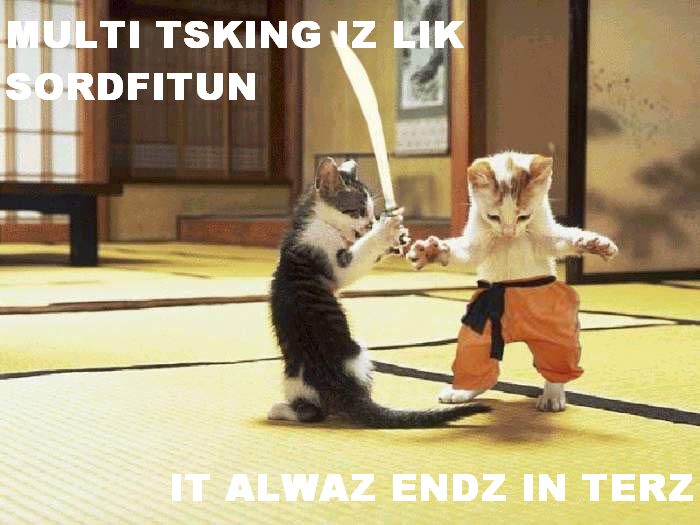
Labels: abi, catherine, Fun, lolcats
Wednesday, July 04, 2007
An anonymous individual posted on Benoit’s Wikipedia page that he was replaced by another wrestler, Johnny Nitro, for a championship wrestling event as Benoit was unable to attend the event “due to personal issues, stemming from the death of his wife Nancy.” A Wikipedia moderator took the post down an hour later on the basis that the statement needed a reliable source. A second anonymous individual then added to the site that “several pro wrestling websites” attributed Benoit’s failure to attend the event to Nancy’s death. This second post was made by an individual in Australia. The second post was then removed by Wikipedia editors on the basis that “several pro wrestling websites” was not reliable. When it was revealed that Benoit, his wife and son had died, Wikipedia editors put the puzzle together and contacted authorities. (see the Sydney Morning Herald report here).
After revealing that they were responsible for the first post, the anonymous individual said that they had made the changes to Benoit’s Wikipedia page on the basis of a number of rumours floating around the Internet. Further, they stated that
"I posted the comment we are all talking about and I am here to explain that it
was A HUGE COINCIDENCE and nothing more…
I was beyond wrong for posting wrongful information, and I am sorry to everyone for this ... I just posted something that was at that time a piece of wrong unsourced information that is typical on wikipedia, as it is done all the time.” (Jano Gibson, “Benoit Mystery’s Wiki Twist: I Did It”, Sydney Morning Herald, 29 June 2007)
So does saying that “I just posted something that was at that time a piece of wrong unsourced information that is typical on Wikipedia, as it is done all the time” make it all right then? No, for a number of reasons. First, while editing Wikipedia has become all the rage, what is the rush in posting the death of an individual before it’s actually been confirmed? Even if this was based on ‘rumours’ – which in this case ended up being somewhat true – I’m not sure of the harm in waiting for a death to be confirmed by more reliable sources before adding it the Wikipedia page. After the Sinbad incident, chances are that Jimmy Wales wouldn’t mind Wikipedia not being updated for a few hours in order to confirm that an individual in question is actually deceased. Second, if the individual is not a prankster and does in fact care about the information on Wikipedia, then surely they should not base their posts on unsubstantiated rumours and seek to dispel the misconception that Wikipedia is the place you go to post inaccurate information.
It's a shame that in such tragic circumstances this is the story that is filling the headlines.
Thursday, June 28, 2007
Labels: catherine, Creative Commons
Monday, June 25, 2007
What's Crown copyright? Crown copyright is essentially government-owned copyright. This means that the government owns the copyright in those particular works, like a company might own copyright, or I own copyright in this blogpost. In addition to general works, governments also own copyright in legislation and case law that is produced by the Parliament or judiciary in that particular jurisdiction. Pursuant to Division 1 Part VII of the Copyright Act, Crown copyright subsists in:
- works "made by, or under the direction or control of the Commonwealth or a State" (section 176)
- works first published in Australia if this first publication is by, or under the direction or control of, the Commonwealth or a State (section 177)
- sound recordings and cinematograph films "made by, or under the direction or control of the Commonwealth or a State" (section 178)
- in addition to these provisions, the Crown owns any copyright materials produced by its employees under the general employment provision contained in the Copyright Act, subsection 35(6).
In 2005, the now-dissolved Copyright Law Review Committee released a report on the Australian Crown copyright provisions and made a number of significant recommendations, including the repeal of sections 176-178 and that copyright in primary legal materials (and a number of other government documents, for example, certain Committee reports) be abolished. The Federal Government is yet to reply to the recommendations made by the Committee.
Is Crown copyright available everywhere? Many countries do not have Crown or government copyright: for example, in the United States, "copyright protection...is not available any work of the United States Government" (17 U.S.C section 105). This means that all government produced works, legislation, case law etc is technically in the public domain (with some scholars arguing that, because of this fact, the 'public domain' takes on an additional significance, because copyright law cannot impede the use and wider reuse of these materials.)
What was CAL v State of New South Wales [2007] FCAFC 80 about? In two words: surveyor plans. Pursuant to a number of NSW statutes, survey plans have to follow certain requirements in order to be registered in NSW. These survey plans are also reproduced for certain purposes by the NSW Government and stored in a database. CAL went to the Copyright Tribunal seeking a determination pursuant to sections 183 and 183A of the Copyright Act as to the amount of royalties that the NSW Government should have to pay to the copyright owners for use of particular plans. However, the State of NSW argued that it was the copyright owner under sections 176 (the plans were made under its direction or control) and 177 (it was the first to publish the plans, therefore, under this section, it owned the copyright). The case was referred to the Federal Court of Australia, where the Full Bench made a determination.
What did the Court find about Crown copyright? The Federal Court found that Crown copyright did not subsist in the survey plans in question under either section 176 and 177. Therefore, the Crown did not own the copyright in these particular plans.
Does that mean the State of NSW lost? The Court found that while Crown copyright did not subsist in the plans, the State was entitled to a licence, beyond what was permitted under section 183 of the Copyright Act, allowing it reproduce and communicate the plan in question to the public. The Court found that the “State is licensed to do everything that, under the statutory and regulatory framework that governs registered plans, the State is obliged or authorised to do with or in relation to registered plans.” (at 158).
What was interesting about the case? To me, the glaring omission was the fact that the court did not discuss the recommendation of the CLRC in its final Crown Copyright report that sections 176 and 177 actually be repealed. There are two issues here. First, it is understandable that the Court may have been reluctant to engage in any discussion of whether the Federal Government should or should not repeal these provisions given that the Government is yet to respond to the review. Second, however, the Court did not even mention the fact that the CLRC had conducted a review into Crown copyright and made a recommendation regarding these provisions. While some may consider that irrelevant to the current point at hand, it seems to me that if you are discussing provisions of the Copyright Act that might not be around in a year, it may be worth mentioning that fact.
Will the decision be appealed? According to this CAL press release, "CAL is considering the decision and will decide on our next move in the next few weeks." Let's all chant softly, "High Court! High Court! High Court!"
How do you know all this?
Copyright Agency Limited v State of New South Wales [2007] FCAFC 80 (5 June 2007)
"Court decides surveyors own copyright in maps and plans", CAL News Release.
Catherine Bond, "Reconciling Crown Copyright and Reuse of Government Information: An Analysis of the CLRC Crown Copyright Review", (2007) 12 Media & Arts Law Review (forthcoming), available on SSRN as part of the UNSW Faculty of Law Research Series here.
Labels: cases, catherine, Crown copyright
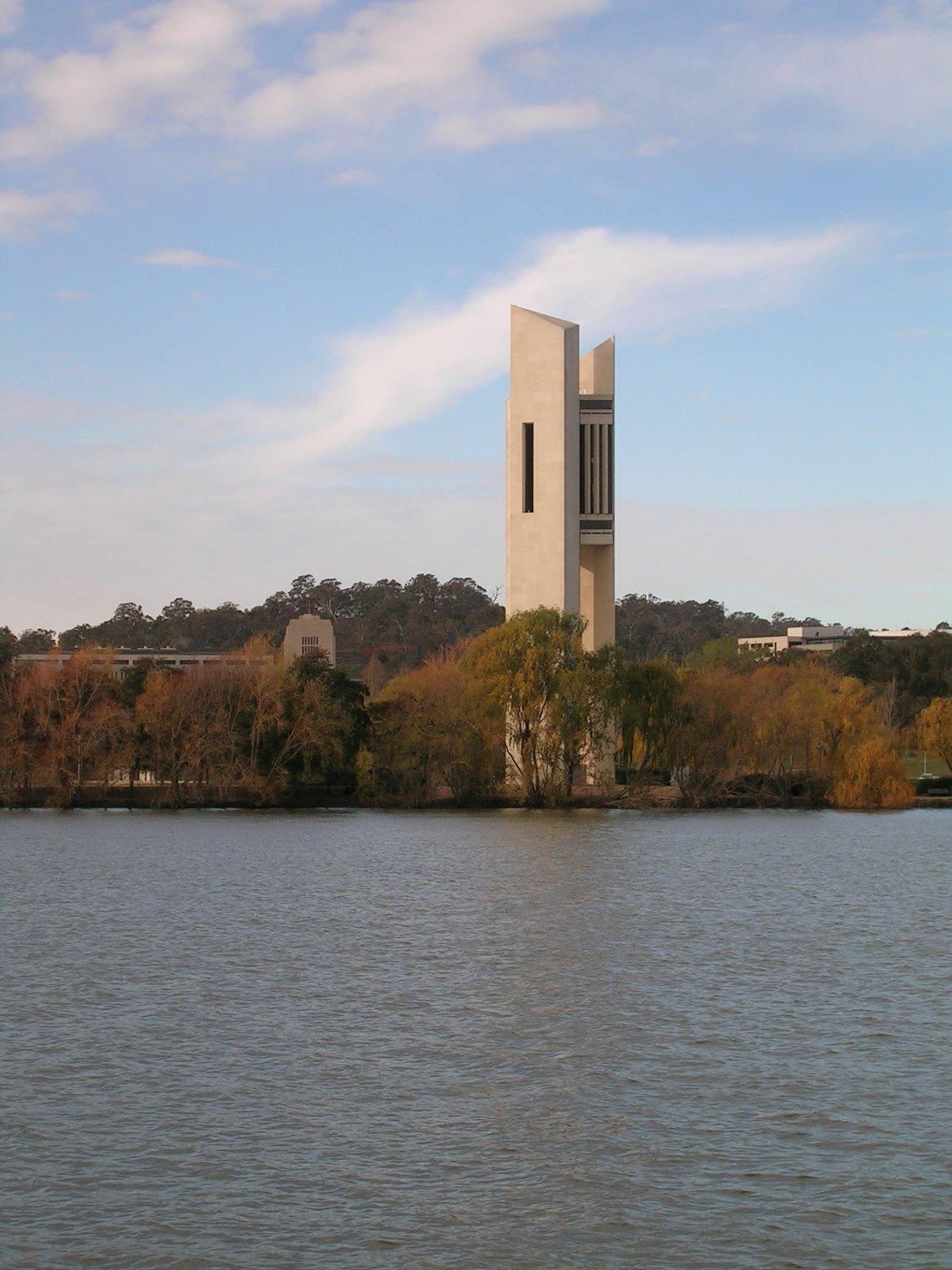
We have recently discovered that this is the National Carillon (excellent photography by Catherine Bond).
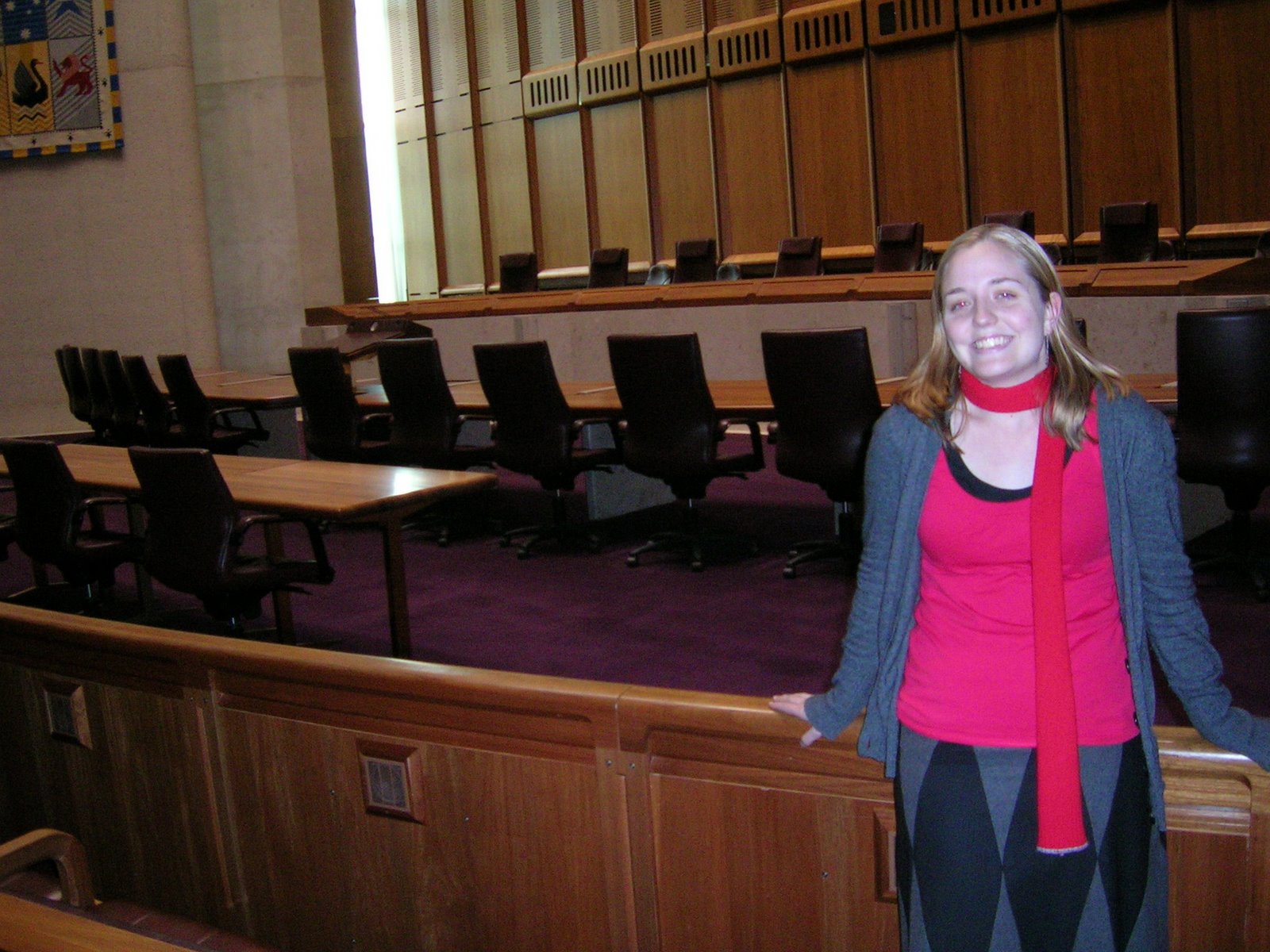
Catherine was keen to get a new job at the High Court but was told by a security guard that the position of Chief Justice was not yet available (but he took her name for future reference - or possibly - to keep her out in the future).

Finally, as you can tell by the expression on Abi's face- Canberra can be downright joyful (despite the cold)!
If anybody feels that our photos do not truly reflect the essence of Canberra, Matthew Rimmer has kindly suggested the following places:
(Pictured: "Cath's shot of the Carillon", "Cath at the High Court" and "Joyful Abi", Catherine Bond, Pictures available under either a AEShareNet
 license or
  Creative Commons Attribution 2.5 License.)
Saturday, June 23, 2007
Update: Additional news about the story is starting to hit the mainstream media. According to a Sydney Morning Herald report, US District Court Judge Claude M Hilton took account of the fact that Griffiths served 3 years in Australian prisons, so he will only seve 15 more months (in a United States prison). This puts to rest fears that Griffiths had expressed to his father that the judge would not take into account those three years served in jail prior to his extradition to Virginia (see those here).
It's been quite interesting actually to see how our local news media handled the story. Just after the sentence was announced the Sydney Morning Herald picked up this AFP story about the case, titled "Briton sentenced to 51 months prison in US for internet piracy." Griffiths is in fact British, having never gained Australian citizenship after arriving in Australia aged 7. Both the mainstream Sydney Sunday newspapers, The Sun-Herald and the Sunday Telegraph picked up the story with the Sun-Herald story reproduced on the Sydney Morning Herald site here. So the case has been getting coverage, although perhaps not as much as might be expected, given that this was a case involving 1) extradition to the United States and 2) jail sentences for copyright infringement.
Labels: catherine
Tuesday, June 19, 2007
83 teams worldwide have already registered, in places including our hometown of Sydney (with the team headed up by Software Freedom International President and House of Commons friend Pia Waugh), Nigeria, Mexico, Peru, Italy, Scotland and the United States (just to name a few - and with the deadline to register not until 31 July expect that list of locations to grow!)
Labels: catherine, free software, open source
Monday, June 18, 2007
According to reports in The Sun-Herald yesterday, Griffiths will definitely be sentenced this Friday. Further, it is also reported that there has been a plea bargain, which means Griffiths may/will get a reduced sentence. If you are interested in the Griffiths case, we will have a fuller discussion of the case when his sentence is handed down.
Update: Griffiths is also discussed in the context of extradition of individuals by the United States in a Sydney Morning Herald opinion piece by Mark Coultan. As Coultan notes, the Griffiths case "is trumpeted as a victory for US authorities battling software pirates around the globe but it has raised concerns about the reach of American law and the Australian Government's penchant for allowing the US to deal with Australian citizens." Read more here.
Tuesday, June 12, 2007
Labels: catherine
Monday, June 04, 2007
Regular blogging will probably commence again next weekend or early next week at the latest. And we promise to license and upload to Flickr any photos we take that capture the true essence of Canberra.
If you are looking for further information, then see:
FSF Releases 'Last Call' Draft of GPLv3 press release here
Richard Stallman's essay on 'Why Upgrade to GPL version 3' here
The Actual Last Call Draft here
Hat Tip: OSWALD
Labels: catherine, free software, open source
Friday, June 01, 2007
The DRM-free tracks retail at $A2.19, 50 cents more than the DRM-ed songs that retail at $A1.69 and according to Apple these songs are better quality. For those cursing the fact they've bought an EMI song with DRM but could now get it DRM-free, Apple has stated that where the DRM-free track is available, users can "upgrade existing purchases" by paying the extra 50 cents for the song or about $5.10 for an album.
Will this be the day that DRM died? I have to admit I'm not sure, and it will be interesting to see whether iTunes Plus is as popular as Apple's other products (iPods) and services (legal downloads!), although all signs point to yes.
(Author's Note - A Google search reveals that many individuals are asking whether this decision by Apple and EMI is the "day that DRM died". Seems as though all of us bloggers instantly thought of those immortal American Pie lyrics!)
Labels: catherine
Tuesday, May 22, 2007
Mark Helprin, an American author, has published an opinion piece in the New York Times about why perpetual copyright is worthy of greater consideration. See it here. To me, Melville Nimmer in his 1970 article, "Does Copyright Abridge the First Amendment Guarantees of Free Speech and the Press", really encapsulated the issue of perpetual copyright when he stated, "If I may own Blackacre in perpetuity, why not also Black Beauty?" Helprin concludes that "Congress is free to extend at will the term of copyright. It last did so in 1998, and should do so again, as far as it can throw."
Obviously, here at the House of Commons we are against further term extension and perpetual copyright, because both are not only seriously detrimental to the public domain but create further problems, including that of orphan works. As part of my thesis work at the moment I'm actually looking at the permissibility of perpetual copyright in Australia and whether it is constitutional - but that is a post for another day!
Hat Tip: Freedom to Differ.
Labels: catherine
Thursday, May 17, 2007
Labels: catherine, free software, open source
Wednesday, May 16, 2007
In the article, penned by Dylan Bushell-Embling, House of Commons friend Dr. Matthew Rimmer points out that while the chance of being prosecuted for posting the key is "slight", it is still illegal under Australian copyright law given the new provisions that were implemented under the Australia-United States Free Trade Agreement and last year's Copyright Amendment Act. Read more here.
The situation of Hew Griffiths is noted in the SMH article, and perhaps Australian bloggers should be even more careful regarding any actions that might possibly infringe copyright law given Griffiths's current position. My housemate Abi blogged about Hew Griffiths back in February, where in the blogpost title the question was asked, "The David Hicks of the Copyright World?" (See that post here). Griffiths was extradited to America for breaches of copyright law and will be sentenced for these copyright crimes on June 22. Griffiths faces 10 years in prison plus the possibility of a very hefty fine.
A few months ago my housemate Abi posted an xkcd cartoon featuring the immortal words, "Sometimes I just can't get outraged over copyright law" (see that post and cartoon here). I find that's particularly the case when there's something in copyright law that's particularly outrageous, and the current climate (as we will discuss in other posts later this week) seems to fall into that category.
Labels: catherine
Tuesday, May 15, 2007
One of the areas that the Unlocking IP project is aiming to focus on is the interaction of copyright collecting societies and commons, and it will be interesting to see who takes up this new role in the long term and what impact this has on CAL, copyright law and the commons in Australia.
Labels: catherine
Thursday, May 10, 2007
The first, ‘A Guide to Developing Open Access Through Your Digital Repository’, is aimed at helping users understand the issues in developing and building open access digital repositories.
The second hits quite close to home for both myself and my fellow housemate Ben. Titled 'Copyright Guide for Research Students: What you need to know about copyright before depositing your electronic thesis in an online repository', its aim is to assist research students in understanding their copyright rights, obligations and responsibilities when adding their theses to digital respositories.
Both guides are licensed under Creative Commons Australia licences. I'm thrilled at the release of these reports. Even as an individual whose thesis focuses on aspects of copyright law, there are so many copyright questions that arise in relation to your thesis, publishing, digital repositories etc. that it's hard to keep track of them all!
Labels: catherine, open access
Friday, April 27, 2007
As you may remember from an earlier post, Jimmy Wales has this week been touring Australia and speaking at various capital cities (he was also here for our public holiday ANZAC Day - I wonder if he had to look up the Wikipedia page for it?) Yesterday, Wales spoke at the Hilton here in Sydney. And there he was confronted by Andrew Hansen from the Chaser, who had decided that Wales would be perfect for a Chaser segment called "Mr Ten Questions". Wales was asked ten questions in rapid succession, including such gems as "There are 1.7 million articles on Wikipedia; how long did it take you to write them all?" and "How do you feel about the fact that when I looked you up on Wikipedia this morning I changed your page to say that you were a teenage drug lord from Malaysia?"
In being asked the Ten Questions, Wales now joins an elite list, although only one of the Ten Question candidates has ever got all the answers right - actor Anthony LaPaglia.
You can read more at the Sydney Morning Herald article on this here. As the SMH points out, this is quite a minor stunt by the Chaser guys. As the Wikipedia page on The Chaser, these guys were on the official list of potential terrorists, anarchists and protestors "deemed to be a threat" to United States Vice President Dick Cheney on his recent visit to Australia. So it seems that Wales got through this easy!
Thursday, April 19, 2007
Wikipedia: Different aspects of Wikipedia are considered in three articles. Dennis Wilkinson and Bernando Huberman assess the value of cooperation in Wikipedia here; Anselm Spoerri has created a qualitative study on the 100 most visited Wikipedia pages between September 2006 - January 2007 here; and Spoerri also asks, in a separate article here, what is popular on Wikipedia and why?
Open Access/Content/Source: Four articles address different aspects of the "open" revolution. After my discussion last week on open source cinema (and Snakes on a Plane!) I found Stefan Gorling's article Open Source Athletes particularly interesting - see that here. Peter Kaufman looks at open content, education and videos here; Paul Stacey look at open educational resources in a global context here ; and finally, Anna Winterbottom and James North combine a lot of issues, discussing the creation of an open access African repository based on Web 2.0 principles here.
Labels: catherine, open content, open source, wikis
Friday, April 13, 2007
The prime example of this, of course, is last year's classic thriller Snakes on a Plane (or "SoaP"). New Line Cinema intended to change the name of this film from Snakes on a Plane to Pacific Air Flight 121 but outrage on blogs meant they kept the original title (although really, couldn't execs think of a better title than 'Pacific Air Flight 121'?) Following other demands, a certain line which, because this is a family-friendly blog will not be mentioned, was also inserted into the film. You can read more about open source cinema, and that particular Samuel L. Jackson line, at the Sydney Morning Herald article here.
When we started this blog I never, ever, thought that I would get to mention Snakes on a Plane. The House of Commons is now part of SoaP history.
Labels: catherine, Fun, open source
Wednesday, April 11, 2007
For all our Australian readers, IP Australia has a list of World IP Day Events that can be found here. At the Sydney event one of the seminars will discuss "IP management and licensing". Will this include consideration of open content licensing? Stay tuned.
Labels: catherine
Thursday, April 05, 2007
Andres Guadamuz has an excellent analysis of the case over at Technollama, and concludes "I do hope we get a case out of this, as it would be interesting for many different reasons. So, in other words, "fight, fight, fight!"" I have to agree. This type of case, combined with the Viacom v. YouTube case tend to have us intellectual property-types foaming at the mouth, waiting to see what will happen next. Sad, but true.
Hat tip: Technollama and Michael Geist.
Labels: cases, catherine, Creative Commons
Monday, April 02, 2007
A big "thank you" must go to the SCRIPT-ed team for their hard work in putting this journal edition together!
(Note: Don't miss out on "Finding and Quantifying Australia’s Online Commons" and "Simplification and Consistency in Australian Public Rights Licences" written by housemates Ben and Catherine and included in this special issue!! -- Abi)
Labels: catherine, conferences, open content
Tuesday, March 27, 2007
 It's amazing how quickly some things can change and it's definitely a good sign when things do. In his latest, very recent 2007 article, R. Anthony Reese discusses the "new unpublished public domain" and, among other issues, discusses why, for example, some authors or their families might want to keep unpublished material private.
One of the examples that Reese gives is the estate of James Joyce, who died in 1941. Stephen Joyce, James Joyce's grandson and the controller of his literary estate, is notoriously protective of any unpublished material relating to his grandfather and family and, as this material remains under copyright law, it is easy to control publication of the material. One of the reasons Reese identified for Stephen Joyce being so protective of this material is because of its references to James Joyce's daughter Lucia, who spent some time in a mental asylum.
Between the publication of Reese's article, however, and the last few days, this situation has changed.
Back in 2003, Professor Carol Shloss was working on a biography of Lucia Joyce, titled "Lucia Joyce: Dancer in the Wake", when she was contacted by Stephen Joyce and told she was not permitted to quote from a considerable number of materials still controlled by the Joyce estate. Shloss was forced to make significant alterations to her text and delete many of her opinions conforming to the amount of quotation the Joyce estate considered 'fair use.'
In 2005 Shloss made a private supplemental website containing supporting material which she was forced to remove from the book. The Joyce estate threatened legal action against Shloss if she made the website publicly available. But would the Joyce estate succeed with said legal action?
Enter the Stanford Centre for Internet and Society's "Fair Use Project" ('FUP'). The FUP, which began in 2006, provides legal support on projects designed to "clarify, and extend, the boundaries of 'fair use' in order to enhance creative freedom." In June 2006 FUP filed a lawsuit on behalf of Professor Shloss, in order to establish her right to use "copyrighted materials in connection with her scholarly biography of Lucia Joyce."
Last week, the Joyce estate agreed to enter into a settlement agreement permitting Professor Shloss to publish quotations relating to James and Lucia Joyce electronically, and in a book. This is a particularly significant outcome given the situation identified earlier. In the words of Shloss:
"I fought not just for Lucia and Joyce, whose words had to be taken out of my book, but for the freedom to consider what happened to them and for the freedom of others to respond to my ideas. 'Fair use' exists to foster this liveliness of mind; its measure is in transformation not in a restrictive counting of words. Everyone who worked on this case understood that something far more important than my particular book was at stake in the fight. It was an honor to work with them." (source)
Sources/I Want to Learn More!
Stanford Scholar Wins Right to Publish Joyce Material in Copyright Suit Led by Stanford Law School's Fair Use Project, Digital50.com
An Important Victory For Carol Shloss, Scholarship And Fair Use, Anthony Falzone, CIS
R. Anthony Reese, "Public but Private: Copyright's New Unpublished Public Domain" Texas Law Review, Vol. 85, pp. 585 - 664 (particularly pages 618 - 619), 2007.
Matthew Rimmer, "Bloomsday: Copyright Estates and Cultural Festivals" Script-ed, Vol. 2, No. 3, pp. 383-428, September 2005
Post written by Catherine Bond and Abi Paramaguru.(Pictured: "365 - Day 32 - Happy Birthday James Joyce!", daryldarko, available under Creative Commons Attribution-NonCommercial-NoDerivs 2.0 License)
Thursday, March 22, 2007
One of these, current NSW Premier Morris Iemma's, appeared to be - if only for the fact that it didn't contain a great deal of content. Sadly, however, the case has now been cracked and the site revealed to be a sham.
Andrew Donnellan kindly emailed me and pointed out:
"According to 'Morris Iemma's' MySpace profile:Andrew then revealed the problems with these details:Status: Single
Zodiac Sign: Aquarius
Children: I don't want kids
46 years old"
"Firstly, he is married. Secondly, his star sign is Cancer, according to the DOB on wikipedia. Thirdly, he has four kids. And he'll be 46 in three months time...he's still 45."The sad conclusion to this is that appears MySpace is lost to Australian politicians forever...
Labels: catherine
Tuesday, March 20, 2007
 Over at Freedom to Differ, Peter Black has blogged about the social networking site MySpace creating a page about politics in the lead-up to the 2008 United States Presidential election. Read more at Freedom to Differ here. Here in New South Wales we're having a state election on Saturday. All this talk of elections, combined with Pete Black's post, made me wonder: do the candidates for Premier in our state election - Morris Iemma and Peter Debnam - have MySpace pages?
The answer is yes and no. Morris Iemma does, and it can be found here. Peter Debnam does not. However, as I started to click my way around MySpace, I became transfixed by the number of political profiles on MySpace. Unfortunately, it soon dawned on me that I couldn't tell which MySpace profiles were legitimate and which were not. This led me to my next question: are any of the Australian politician MySpace pages legitimate?
I can't imagine that ex-Australian Prime Ministers Bob Hawke or Paul Keating would really be workin' MySpace. The same goes for former Queensland Premier Sir Joh Bjelke-Petersen, given that he passed away in April 2005. However, some of the pages - like those for Queensland Premier Peter Beattie and Victorian Premier Steve Bracks look kind of legitimate. Until you start to read the details.
MySpace came under fire only a short while ago, in January this year, after Justice Michael Kirby, of the High Court of Australia, was the victim of a particularly defamatory, fake MySpace profile. See the Sydney Morning Herald article on this here. According to the SMH story, the site was available for about 15 months.
Now, I'm all for social networking, commons-based peer production, expressing yourself, etc. In Australia, we also have a great tradition of parody and satire, with shows like The Panel and The Chaser "sending up" pretty much everything. However, there is something that troubles me about individuals creating non-legit MySpace pages about Australian politicians (and other individuals, actually) purporting to be the real deal and then putting up defamatory, offensive, and untrue content. In my opinion, if the author admits that the site is a parody (or it's an obvious parody) and denounces any affiliation with the individual in question, then that's more acceptable. However, when people see content on these fake pages that indicates to them the site is real, that's more problematic. When the site defames the person in question and the user can't tell if the page is legitimate, that's even worse.
This weekend, my fellow New South Welshmen and I will take to the polls to fulfil our democratic duty. In return, I'd like to pose a challenge to all Australian politicians: if your MySpace page is legitimate, please let us know! I realise that Morris Iemma probably has a bit to do with an election in five days and everything, but at least one person (i.e. this blogger) will sleep better knowing that MySpace is still being used for some good...
Author's Note: A big thank you to my housemate Abi for her assistance with this post!
(Pictured: "Join Myspace", Randall Munroe - via his excellent webcomic xkcd, available under a Creative Commons Attribution-NonCommercial 2.5 license)
Labels: catherine
Wednesday, March 14, 2007
According to reports, the commencement of the lawsuit by Viacom comes after a "great deal of unproductive negotiation" with Google and YouTube. Let's see if more productive negotiations can occur now, or whether the case makes it before the courts. Sadly, it's cases like this which makes us copyright law-types wait with baited breath.
Labels: catherine, infringement
Monday, March 12, 2007
So when I saw that the FAIR USE Act of 2007, still at Bill stage, had been introduced into Congress, I knew it was something to do with copyright. And because it was about copyright, I knew that I should get blogging on it.
I do know, however, that not everyone who reads this blog is a lawyer, or familiar with the American legal doctrine of fair use. So let's recap, shall we...
What is fair use? Fair use is a United States legal doctrine that permits certain usage of copyright material, without requiring the user to go seek the permission of the copyright owner. It's been invoked in a number of cases; probably the most famous was the Betamax case where the US Supreme Court held that the taping of TV shows was a fair use. Basically, it's a non-specific doctrine that a lot of otherwise copyright-infringing activities will be caught under. Given that Australia has specific exceptions, it's broader than any permission we enjoy.
What's the FAIR USE Act then? "FAIR USE" in this context stands for the Freedom and Innovation Revitalising U.S. Entrepreneurship Act. You can find it here on the Electronic Frontier Foundation's "Support the FAIR USE Act" page.
Huh? Precisely. A few years ago, the United States Congress introduced the Digital Millennium Copyright Act (DMCA). This Act introduced new provisions regarding the circumvention of technological protection measures (unauthorised keys to digital locks, basically). Under this legislation, a lot of unfair cases emerged. Even though it was supposed to be aimed at copyright infringement, it was used in cases where the plaintiff sought to protect garage door openers and printer cartridges.
And that's what the FAIR USE Act seeks to address? In part, yes. This Bill aims to rectify some of the problems caused by the provisions of the DMCA. A few years on and the community has now seen the impact of these sections on fair use of copyright material. The FAIR USE Act seeks to regain the "balance" of owner and user rights by introducing a number of changes:
1) new sections aimed at limiting damages for secondary liability for copyright infringement
2) expressly codifying (ie, putting into statute) the finding of the Court in the Betamax decision - people won't be liable for copyright infringement "based on the design, manufacture or distribution of a hardware device that is capable of substantial, commercially significant non-infringing use."
3) DMCA amendments - there are a few here:
First, the Bill includes reference to the six classes of "non-infringing uses"
specified by the Librarian of Congress. These uses would permit behaviour that
would normally have violated section 1201(a)(1)(A) of the DMCA, which states
that "no person shall circumvent a technological measure that effectively
controls access to a work protected under this title." On 27 November 2006 the
Librarian of Congress announced that these six classes would not be subject to
the prohibition against circumvention in s 1201(a)(1)(A) for three years. Find
out more here.
Second, the Bill also specifies a number of additional, non-infringing acts of
circumvention. My favourite is the section that will make an act of
circumvention legal where it is "carried out solely for the purpose of gaining
access to one or more works in the public domain that are included in a
compilation consisting primarily of works in the public domain." Admittedly,
this provision is somewhat narrow in its scope, but it does address the issue of
TPMs attached to works that are either in the public domain or enter the public
domain and become unusable due to their digital lock.
When will the Bill be passed? The Bill was introduced into Congress on 27 February 2007, by Rick Boucher and John Doolittle (don't you just really want to go to Virginia after seeing Boucher's site?). Zoe Lofgren is also an original co-sponsor of the Bill. See the Boucher press release here. Doolitle and Lofgren also shared responsibility for the introduction of the still-to-be-passed Public Domain Enhancement Act to the United States Congress following the Eldred v Ashcroft decision.
Americans must be rejoicing! Some are, some aren't. The Recording Industry Association of America has come out against the FAIR USE Act, arguing that it would "legalise hacking" and "would effectively repeal the DMCA." See more of their criticisms here.
I live in Australia. Why's this relevant? Because we just introduced our very own Oz-DMCA. Didn't you read Weatherall's Law? Pursuant to the provisions of the Australia-United States Free Trade Agreement, Australia was obliged to enact TPM provisions substantially similar to the sections of the DMCA. These were formally introduced as part of the Copyright Amendment Act. So it's time we all start drafting legislation in an attempt to convince our legislature to amend these provisions.
My contribution? Building on the American model, I propose the iPODS Act - the Interactive Products for Open Digital Sources Act. I am unsure what this would propose, but I wanted to use the word "iPod" in my Act title.
Labels: catherine
Friday, March 09, 2007
Yesterday the Sydney Morning Herald covered the ongoing controversy of a former college student who posed on Wikipedia under the name of "Essjay" as a professor of theology. Further problems emerged when a "high-ranking member of the Wikipedia bureaucracy" (can we be more specific please?) vouched for "Essjay"'s false credentials. See it here.
I think it's safe to say that, of the commons and copyright-related content that we cover here at the House of Commons, Wikipedia attracts the most attention from the media and the general community. The Copyright Amendment Act held its own last year, but now that's passed and we're all too busy format-shifting CDs onto our iPods to pay it much attention anymore. Creative Commons appears every so often - however, you are much more likely to find criticisms of Creative Commons in academic journals and literature as opposed to the public, general media-based airings of the problems with Wikipedia.
Late last week, I was sent a link to another Herald piece, this one about the Associated Press banning stories on Paris Hilton, "barring any major events", which I guess means the usual trio of pregnancy, marriage, or, um, death. Perhaps here at the House of Commons we should impose the same ban on posts about Wikipedia for a while...barring the usual trio of potential plagarism, spoofs or new wikis of course.
Monday, March 05, 2007
One of these new pages is Conservapedia, which is getting a lot of coverage from both the media and my fellow bloggers (see Andres Guadamuz at Technollama's post here and Pete Black at Freedom to Differ here - both of these are worth a read). Conservapedia is, according to its founders, a "'much needed alternative to Wikipedia', which they say is 'increasingly anti-Christian and anti-American'." (From Bobbie Johnson's article here on the Sydney Morning Herald site). Conservapedia was created in November 2006 and today it boasts over 1 million page views.
Notable pages include its current "Most Viewed Entry": Examples of Bias in Wikipedia, where one example given is that Wikipedia uses British, rather than American, ways of spelling words. In my opinion, I don't think I ever noticed the way certain words were spelt on Wikipedia - as an Australian, we're used to seeing words spelt both ways (is it licence or license?) I just looked for "Colour" on Wikipedia and the page on colours - ie, red, purple, pink etc - is given the heading 'Color'. So it seems that not all Wikipedia pages adopt the British way of spelling. It’s also interesting to look at the Wikipedia page on Conservapedia – see it here – I get the feeling that the Wikipedia and Conservapedia pages on each other will just continue to grow.
While on the topic on other online, peer-produced encyclopedias, there is also Uncyclopedia, the "content-free" encyclopedia, although be warned that it's not for the easily offended. In that vein, I will not be linking to any of Uncyclopedia's pages. Still, it does provide a few giggles and is an excellent example of commons-based peer production - the hours that contributors have spent building up some of the pages is amazing. (There is some interesting coverage on Oscar Wilde - but in order to avoid any kind of legal liability or just a stern telling off from the Powers That Be I will not be linking to that site).
Aside from telling you about interesting pages, however, there is one interesting issue about these new sites. Wikipedia is licensed under the GNU Free Documentation Licence. Another wiki, CreationWiki, is also licensed under the GNU FDL. Uncyclopedia, though, is licensed under a Creative Commons Attribution-NonCommercial-ShareAlike 2.0 licence.
The differences in licences don't matter - I think it's great that everyone's getting into sharing content and licensing products of wikis. Conservapedia, however, does not appear to be licensed. In my opinion, this is something that should be re-thought - everyone knows the best way to get the word out there is licensing!
Friday, March 02, 2007
First, the UNSW Centre for Continuing Legal Education is holding an 'Intellectual Property - Digital Copyright Update' seminar on Tuesday, 13 March, from 8.45 am - 1pm in Sydney. The Cyberspace Law and Policy Centre's own co-director (and House of Commons regular) David Vaile will be chairing the event. Topics everyone's favourite piece of 200-page legislation - the Copyright Amendment Act 2006; online copyright liability following the Cooper decision; and Sony v Stevens and TPMs. Register here.
Second, the University of Western Ontario is hosting two copyright and commons related conferences on 9 and 10 April 2007. The first conference is "Free/Libre and Open Source Software (FLOSS) as Democratic Principle" and scheduled speakers include the free software guru himself, Richard Stallman and Unlocking IP investigator Brian Fitzgerald. The second conference is "Digital Copyright in a User Generated World", which includes talks on open access, virtual worlds, blogs and copyright reform. Find out more here.
So many copyright events, so much copyright legislation, so little time...
Labels: catherine, conferences
Thursday, February 22, 2007
The December 2006 edition is definitely worth a look - titled Jam, the articles range from pieces on code jamming and mash-ups to analyses of making actual jam. Given that one of the benefits of the commons is the ability to take something old to make something new, the articles on jamming are certainly worth a read.
Find the table of contents here, the editorial by Jo Tacchi and Lawrence English here and Em McAvan's interesting article "Boulevard of Broken Songs" here.
For any readers who may be interested to contributing to this journal in the future, upcoming edition themes include Mobile, Error and Vote. Find more about how to submit here.
Labels: catherine
Wednesday, February 21, 2007
Well, we can't answer all these questions, but we can point you in right direction for the last one. The February 2007 edition of the Federal Attorney General's Department eNews on Copyright is a good place to start. From there, two other places to visit are the Copyright Amendment Act page on the Attorney General's Department website and the fact sheets that the AG's has produced on the various new amendments.
Labels: catherine
The first is "Some Thoughts on Orphan Works", an issue that's been discussed on our blog quite a lot in the past. McDonald gives a very comprehensive overview of what's been going on to address the orphan works issue both in Australia and overseas. This article also appears in the October 2006 issue of the Copyright Reporter. (Yes, I know there's a lapse between the release of this article and my blogging about it, but everything from about September last year passed by in a blur due to the Copyright Amendment Act!)
The second is titled "Creative Commons: Just Say 'CC'?" In this article, McDonald covers some of the criticisms of the Creative Commons licensing regime that he's discussed in the past and have also been raised a few times by Niva Elkin-Koren and Kim Weatherall in similar papers. This article was in the December 2006 issue of the Copyright Reporter.
I'm really enjoying writing my thesis on the copyright commons but covering all the relevant literature certainly keeps me busy!
Labels: catherine, Creative Commons, orphan works
Sunday, January 21, 2007
Friday, January 19, 2007
1) Everyone you see is carrying a laptop...
2) Said laptops and laptop bags are covered in stickers, displaying the owner’s software affiliations
3) You see more people wearing baseball caps and t-shirts with obscure software company logos (as opposed to the more usual obscure streetwear logos often found on a university campus)
4) Occasionally, from anywhere in the campus, you hear Jeff Waugh proclaim, "Good afternoon, freedom lovers!"
5) Instead of people on the bus coming to university talking about what happened on last night's episode of Lost or 24, the conversation is abuzz about Tivoisation: a big bad or something that's actually pretty useful?
And to finish off, in the words of Jeff Waugh, so long freedom lovers! I'll be posting about the excellent linux.conf.au Open Day within the next couple of days (stay tuned for Robopuppies, segways and how to solder using a toaster oven in order to create your own aircraft - kids, don't try this at home.)
Labels: catherine, open source
Thursday, January 18, 2007
Wednesday, January 17, 2007
It's a given that any thesis on the commons has to mention Wikipedia, so I've been spending a lot of time there, too. So when UIP associate Roger Clarke sent through to us at the House of Commons an article asking whether 2007 was going to be the "year of the expert wiki", I had to take a look. Find it here.
The article's author, Nate Anderson, points out that there's been a lot of debate over the reliability of Wikipedia in recent months and two new projects, Citizendium and Scholarpedia, seek to combat any reliability controversy by using teams of experts to polish up content (although Citizendium is quick to state on it's main page that it's "expert-led", not "expert-only".) Some readers will be familiar with Roger Clarke's post on Citizendium vs. Wikipedia last year, and Larry Sanger's response. The main pages for both Citizendium and Scholarpedia are worth a look at and it becomes very apparent that there are some big differences between the two.
Anderson also briefly discusses WikiLeaks, which, if you are unfamiliar this wiki, aims to "develop an uncensorable Wikipedia for untraceable mass document leasing and analysis." A brief read of the WikiLeaks front page shows that this group means business. The WikiLeaks group will probably be following the pending Electronic Frontier Foundation/Eli Lilly litigation. The EFF is currently defending the "First Amendment rights of a citizen-journalist" who linked from a wiki to internal Eli Lilly company documents concering a prescription drug. (See more here and Lessig's brief post here.)
Update: See the Freedom to Differ post about Wikiseek, a new search engine company, here. I can't keep track of all this wiki news...
Wednesday, January 10, 2007
Now Linden Lab, the company behind Second Life, has announced that it will release the code of Second Life's "viewer application to the open source software development community." (See the press release here .) The code will be available under the GNU GPL v2 (interesting that they chose not to wait until version 3 is out?) See Lessig's blog here, the Sydney Morning Herald here and then find the actual source code here, plus information about the licensing here. Interestingly, they have also included an additional FLOSS exception - see it here.
This is a big step for the company who seems to be one of the more user-friendly gaming companies when it comes to intellectual property issues. Second Life also seems to be a common international meeting place - Creative Commons had one of its many birthday parties in there and Judge Richard Posner gave a seminar there late last year.
So this is one small step for an avatar, one giant leap for the open source community.
Monday, January 08, 2007
See the details on Wikipedia here and at Lessig's blog here (the fact that Lessig's blogpost about the episode was written in February 2005 serves to further illustrate how far behind we really are.) The ABC also has a description here, with Lessig getting a mention. How surreal it must be to see your name intermixed with fictional characters...
Just in case you’re wondering, if the housemates were ever portrayed by actors, I believe these fine artists would do us justice: Sarah Michelle Gellar (myself), Johnny Depp (Ben) and Australia’s own Bollywood queen Tania Zaetta (Abi).
Labels: catherine, Creative Commons, Fun
Tuesday, January 02, 2007
With this in mind, there are a number of good copyright and commons-related conferences coming up over the next few months that will undoubtedly give us some new perspectives on the many issues that we are all grapping with as copyright protection continues to increase.
linux.conf.au - Sydney, January 2007 - I don't think I've read one bad word about this or any of the previous linux.conf.au's. About 500 hackers will descend on the University of New South Wales in mid-January to attend this conference, with registration still open. The jam-packed programme featuring an all-star lineup can be found here. Pia Waugh and her crew have paid incredible attention to every detail - and how could you not want to attend talks called "How to Herd Cats and Influence People?" or "Sexy Single Source Design (Your Tool Chain of Love)." Even those of us with limited programming knowledge can appreciate that!
Copyright: From The Da Vinci Code to You Tube - Brisbane, February 2007 - This conference, held by the University of Queensland's Australian Centre for Intellectual Property and Agriculture, promises to be very interesting, with the Attorney General Mr. Philip Ruddock giving the opening address and Unlocking IP associates Matthew Rimmer and Rusty Russell also speaking. (Perhaps the first question that might be asked?: Mr. Ruddock, what's your opinion on the Copyright Amendment Blob?)
Creative Commons ISummit - June 2007 - It's in Dubrovnik, Croatia. In a beautiful coastal town. In a beautiful location called the tower Revelin. And you get to talk about building the copyright commons. That's all you need to know.
And, while it may not be a copyright conference it certainly deserves a mention:
Australian Blogging Conference - Brisbane, March 2007 - pioneered by Peter Black, QUT law academic and all-round-excellent blogger, this Australian-first conference is set to be held on 8 March 2007. Given the number of comments that Peter has received on his blog for this up-and-coming conference, it looks like there are many eager Australian bloggers who are looking forward to attending!
If you are organising or attending a conference that you think should be added to this list, then get in touch and we'll happily make any additions.
Labels: catherine
Friday, December 29, 2006
Creative Commons Taiwan has since created a licence compatibility "wizard", which is very user-friendly and looks a little like a tic-tac-toe-ish. See the Creative Commons webblog entry about it here and the English version of the wizard here (for the multilingual commoner, the traditional Chinese version can be found here)
Labels: catherine, compatibility
Friday, December 22, 2006
Read the article here, and credit must go to Peter Black at Freedom to Differ for being very quick off the mark in picking these things up.
It's great to be reading about Creative Commons in our local media, although I have to admit I was slightly stunned when I saw the words "Creative Commons" and "Sydney Morning Herald" in the same sentence and briefly wrote it down to a Christmas/sugar-induced hallucination. Admittedly, the article is an AP report, but kudos to the SMH for picking it up.
The article describes Creative Commons as pushing "copyright lite", a term which I will be sure to include in my thesis (as it will be the only time I can get away with including the word 'lite' in a doctoral thesis.)
Labels: catherine, Creative Commons
Thursday, December 21, 2006
On the 6th Day of Christmas: Start writing your submission to the Federal Government for when the provisions of the Copyright Amendment Act come under review. Need to remember what all the problems were? See House of Commons posts by Matthew Rimmer, Sarah Waladan and myself for inspiration!
On the 5th Day of Christmas: Wishing for a white Christmas? How about a Christmas of white pages? For some holiday reading, start with the OAK Law Project Report, which highlights the importance of open access in all areas of scholarship, continue with Yochai Benkler’s The Wealth of Networks and finish up with Lawrence Lessig’s latest tome, Code v2, all of which are licensed under Creative Commons licences.
On the 4th Day of Christmas: Write a Christmas song and license it. Really, how many more times do we need to hear "Rudolph the Red Nose Reindeer?" (There's a Wikipedia page for everything, isn't there?)
On the 3rd Day of Christmas: Try and imagine the Land of Copyright Maximalism and Perpetual Protection, where nothing will ever be free for reuse and use this place to scare small children who’ve had too much sugar and keep misbehaving. (“If you quote The Aristocats one more time the copyright police will be around here and they’ll arrest you, because you’ll be over the 10% criticism or review limit!”) Not only will this give kids a good telling off, you'll also help the commons by getting the younger generation involved in these issues! Everyone's a winner!
On the 2nd Day of Christmas: Give someone a public domain book as a Christmas present (preferably one that hasn’t been somewhat overexploited by Hollywood.) You never know, that book may inspire that next Clueless (based on Jane Austen’s Emma), West Side Story (based on Romeo and Juliet) or Bridget Jones’s Diary (which is kind of based on Pride and Prejudice)...
And...drumroll please.....
On the 1st Day of Christmas: Help expand the commons here at the House of Commons. Let us know your thoughts in the comments section, or contact us if you are interested in doing a guest post. We here at the House of Commons want to wish you a very merry Christmas and a wonderful New Year, and thank you for all your support as we’ve got off the ground this year! So feel free to pop in to the House and have a glass of egg nog (do we actually drink that in Australia?)!
Labels: catherine
Sunday, December 17, 2006
See the Freedom to Differ post with more information and links here.
Labels: catherine, Creative Commons
Friday, December 15, 2006
 Here at the House of Commons we’re slowly starting to get over the Copyright Amendment Act and look to the festive season with glee. These amendments will have an enormous impact on the copyright commons in the future, but I’ve compiled a list so that, this Christmas, we can start to reduce some of the damage done. Here are the first six.
On the 12th Day of Christmas: Update a Wikipedia page. Know a fact that few others do? Join Wikipedia and let the whole world know.
On the 11th Day of Christmas: License a work under a Creative Commons licence, or a licence of your choice. This is a gift you can give to everyone (note on behalf of everyone: a CC-licensed picture is better than socks).
On the 10th Day of Christmas: Brew up some free beer (and remember to share your recipe).
On the 9th Day of Christmas: Register for linux.conf.au – if you’re a source-y type, you might think that all your Christmases had come at once when you get to attend this conference.
On the 8th Day of Christmas: Make your Christmas cards out of Creative Commons-licensed images that you can find on flickr. Use the search engine here to find pics. Think about licensing any changes you make to pictures under a Sharealike licence, so that you not only give to your friends but give to the commons too.
On the 7th Day of Christmas: Feeling a bit scrooge-y? Read A Christmas Carol by Charles Dickens. And since it’s a public domain work, you can find it here at Project Gutenberg.
That's all for now...stay tuned for the next six in the coming week!
(Pictured: Smilin' Snowman, ShazzMack, licensed under a Creative Commons Attribution-Commercial-Sharealike 2.0 license)
Labels: catherine
Sunday, December 10, 2006
Obviously, the trend in licence drafting seems to be to err on the side of being ultra-specific so that, should the licence ever come before a court, a judge can be guided by the licences terms. However, if we want people to actually read and understand the licences, then in my view less is more.
The Creative Commons “three version approach” is an excellent method of allowing non-lawyers (or “humans” as the Commons Deed describes them) to understand what they can and cannot do with the licensed content. As we have seen though, critics have said that the “Human Readable Code” and the “Lawyer Readable Code” previously differed slightly, particularly when it comes to licence provisions regarding “derivative works” and these flaws were only evident when reading the “Lawyer Readable Code”.
Some licensing organisations however, for example, Creative Commons, should be congratulated for creating so many resources that users can read to find out more about their rights and obligations. Australian licensing organisation AEShareNet also deserves the same praise – their 22-page glossary is enormously helpful. These educative efforts go a long way in helping ordinary Australian users understand copyright law (and me, by the way – don’t judge me, it was a very long Act even before the recent 200 page amendments!)
This brings me to the Copyright Amendment Act. The first recommendation of the Senate Legal and Constitutional Affairs Committee report into the provisions of the Bill stated that the Government should undertake a “public awareness campaign and develop a ‘plain English guide’” that would help people understand what the amendments mean.
What a positive step this would be - because, let’s face it, copyright isn’t getting any easier to understand. Possibly my next-favourite Copyright Amendment Bill quotation (after Senator Andrew Bartlett’s) was from the Hon. Mr Duncan Kerr, who said, “copyright legislation now is a bugger’s muddle as far as the ordinary citizen is concerned.” (House of Representatives Hansard, 1 November, p. 27) I’m not entirely sure what a “bugger’s muddle” is but you get the picture. How can licence drafters be expected to make licences shorter and easier to understand if our national copyright law continues to expand in length and density?
This makes me think that perhaps it will fall to voluntary licensing to inspire governments to make the change from lengthy copyright law to simple, understandable provisions. Here’s hoping the “Human Readable” version of the Copyright Amendment Act comes out soon!
P.S. - I tried to use Flickr to find a CC-licensed picture of someone looking “confused” that I could add to this post. Instead, I ended up both dazed and confused as I searched through the 5100 photos that came up after I typed “confused” into the Creative Commons/Flickr search engine. Pity the poor people whose perplexed expressions are now free for reuse!
Labels: catherine
Thursday, December 07, 2006
 When the exposure draft of the Copyright Amendment Bill was released a little over two-and-a-half months ago, I have to admit I was blinded by love: I was just so happy that the Federal Government was going to make it legal to tape shows off the TV for later viewing and copy music onto my beloved iPod. Like any girl, I was willing to look past any flaws because of what I believed were gems in front of me.
All this time later, and what a fight it's been. The amendments were passed by the House of Representatives on Friday, Attorney General Mr. Philip "tougher on pirates, fairer on consumers" Ruddock (as I've heard him say here, here, here, and just two days ago here) has done an FAQ, and the Bill should receive Royal Assent on January 1 2007. Who could have predicted the many problems that came out of this Bill? It seemed that with each day, and with each view of Weatherall's Law, the problems just kept getting bigger and uglier.
At first, it seemed like the technological protection measures were the biggest nasty in the Bill. But then we all started to have a look at the new enforcement provisions, and that's when the penny dropped. Strict liability offences? For copyright law? That was pretty much when many of us – including Australia's "pesky academics" as the Australian Financial Review described them (tongue in cheek); industry organisations like the Internet Industry Association, Google, and Apple Australia; consumers and associated organisations like CHOICE; and, oh, voters - went into overdrive.
"This Bill is bad!" we cried. Free Mickey? That's so five years ago! Free the iPod! Free consumers! I could see the criminal poster: "Wanted for copyright crimes: CD Burner. Last seen producing illegal copies of Billy Joel's Piano Man." Well, the Government, to their credit, listened, and removed a number of the strict liability provisions.
And, admittedly, the Bill is not all bad. In addition to the time-shifting and format-shifting provisions, the Government also introduced another fair dealing exception, this time for satire and parody. A number of educational reforms were also introduced, so that educators won’t be financially charged for caching online materials used for educational purposes. The Government also clarified a number of changes made under the Copyright Amendment (Digital Agenda) Act 2000.
Now the Bill has been passed and, according to Ruddock, we are leading the way in copyright reform. What a day - Australia wins the 2nd Ashes test and we are leading the way in copyright! (If you detect a note of sarcasm in this post, then that's because, as you can probably guess, I'm a bit copyright-ed out.)
Just one final note though, perhaps Senator Andrew Bartlett deserves the last word on this Bill, for his acute ability to see the truth. As he said in the Senate Debates on the Bill, the Government took a bunch of different issues and put them together as "one congealed wobbling blob." (see the Senate Hansard, 30 November, p. 102) Here's to you, congealed wobbling blob of copyright.
(Pictured: "Congealed Wobbling Blob of Copyright", Abi Paramaguru, Picture is available under either a AEShareNet
license or Creative Commons Attribution 2.5 License.)Labels: catherine
Sunday, December 03, 2006
Friday, December 01, 2006
See it here at our blog or here in the ASK-OSS newsletter, which every month delivers a great read about what's happening in Australian open source right to your inbox!
Labels: catherine
So here's what you can expect over the next few posts:
- A rundown of the General Public Licence version 3 (GPLv3) and Australia symposium that the Cyberspace Law and Policy Centre held on Thursday 30th November, with the help of Linux Australia. Housemate Abi Paramaguru was responsible for organising the event, which was enjoyed by all - so congratulations on an excellent job, Abi!
- A discussion of the OAK Law Report - I was lucky enough to attend the Sydney launch of the report on Thursday 30th November. The (now infamous) Copyright Amendment Bill and the OAK Law Report are about the same length - and I know which one I'd rather read (hint - it's the one that's licensed under a Creative Commons licence!)
So even with the silly season approaching it's full steam ahead here at the House of Commons!
Labels: catherine
Tuesday, November 21, 2006
Concerns about the criminal provisions are gaining momentum: the Sydney Morning Herald has published an article online titled "The $65,000 Question: Do you Own an iPod" featuring heavy criticism of the proposed new offences.
Labels: catherine
Thursday, November 16, 2006

Here at the House of Commons we’re always happy when “Unlocking IP” Partner Investigator, Linux Australia VP, Software Freedom International President and all-round excellent multi-tasker Pia Waugh stops by for a coffee and chat about why open source is so important. That’s why we’re very happy to note that Pia has been dubbed “Linux Australia’s cover girl” by Computerworld. Check out Pia's interview here.
Labels: catherine
Thursday, November 02, 2006
A larger post on the many issues that this Bill creates is forthcoming, but Unlocking IP participants have been very active in government consultation on the Bill. Submissions to LACA were due on Monday 31st October, and the following submissions by Unlocking IP participants can be found here on the LACA website, as listed:
9 - Linux Australia - Unlocking IP Industry Partner
21 - Open Source Industry Australia - Unlocking IP Industry Partner
37 - Professor Graham Greenleaf, Alana Maurushat, David Vaile, Catherine Bond and Abi Paramaguru - Unlocking IP investigators and researchers
46 - Professor Brian Fitzgerald - Unlocking IP Chief Investigator (with Jessica Coates, Nic Suzor, Damien O'Brien & Bjorne Bednarek)
47 - Catherine Bond, Alana Maurushat and Professor Graham Greenleaf - Unlocking IP investigators and researchers
The public hearing for the Bill will take place on Tuesday 7th November, with LACA due to report by 10 November.
Labels: catherine
Monday, October 23, 2006
A Google search revealed that this topic has –unsurprisingly - been picked up by the world’s media and has been analysed on a number of sites. The majority of these sites have discussed the story with the same tongue-in-cheek quality as the AP report on the SMH site. However, all joking aside, it’s great that kids are learning about copyright and infringement. But why not take it one step further and introduce a “Copyright Commons” or similar patch? Surely the values espoused by the open content and open access movements are in the same vein as those that Boy Scouts aspire to. Sharing gives you the same warm, fuzzy feeling whether you’re sharing a canoe, tucker cooked at a campfire, or some content that you created last night on your computer. To achieve this patch, the Scouts could launch campaigns against copyright term extension in areas where copyright hasn’t been extended to life-plus-70 years or create plays based on the Eldred v Ashcroft litigation (characters could include Lawrence Lessig, the Justices of the United States Supreme Court and Mickey Mouse -- oh, hang on a second, the play probably can't include Mickey Mouse!)
Even if the Boy Scouts don’t pick up on my idea, at least this group will be unlikely, in the years to come, to ask that age-old question: “Is it legal to copy my CDs onto my iPod?” In fact, perhaps that should be the first lesson.
Labels: catherine
Friday, October 13, 2006
Carman also dedicates a footnote (p. 59, fn 33) to discussing the ‘public commons’, distinguishing the commons from the public domain. Carman states that he has used to the term “public commons to describe these elements which under no circumstances constitute private property.”(p. 59, fn 33). He purposely chose to avoid using the term ‘public domain’ because of the confusion that this term creates. Interestingly, it seems that the similarities and differences between the commons and public domain are still yet to be solved…and that will make an interesting post in the future! Returning to Carman, as far as I know, this is the earliest usage of the term ‘commons’ in relation to creative content – but if anyone can identify earlier use then let us know!
We want to make sure that the term the “commons” remains common for all to use and this usage is not dominated by any particular connotation, group or organisation. We hope that naming our blog “House of Commons” promotes the ‘commons’ and encourages widespread use of the term.
Although maybe no encouragement is needed: see the Academic Commons, the Digital Library of the Commons, the Environmental Commons, the Cricket Commons (admittedly, the last one isn’t a “commons” exactly but a set of luxury suites in Philadelphia, USA, but with cricket season underway in Australia I wanted to see if there was a ‘cricket commons’….)
Labels: catherine


 (The House of Commons RSS feed)